Reindeer

Reindeer

Also known as caribou, they form vast herds over the Arctic plains


What you need to know about the Reindeer

Our Expert Says… "Almost all the reindeer herds in existence today have had close relationships with humans for thousands of years. As people learned to follow and then drive the herds and take some of the animals for meat, they also helped to protect the reindeer from predators like wolves who might threaten this source of food. It's for this reason that this almost symbiotic relationship has developed, a precursor to true domestication of animals."

The reindeer is known as the caribou in North America. They are found in the arctic and sub-arctic areas of North American, Europe, and Russia in habitats including forests, mountains, and tundra. There are more than 15 sub-species of reindeer currently recognized.

Wild reindeer can be migratory and sedentary and their herding habits vary by location. There is a migrating herd of Siberian reindeer almost 1 million strong for example, although North American caribou populations seem to be under pressure, with herd sizes down to under 10,000.

Some of the North American sub-species can claim to have the longest migrations of any land mammal, covering over 3,000 miles every year. As well as long-distance stamina, reindeer can move quickly when they need to. Adults can run at up to 50mph, and even day-old calves could outsprint Usain Bolt!

Reindeer have special adaptations to survive in harsh Arctic weather. One such is that the arteries and veins in their legs are closely intertwined, allowing the returning cooler blood in the veins to lower the temperature of the arterial blood. This method of heat exchange minimizes the amount of heat the caribou loses through the skin, enabling them to regulate their body temperature in greater extremes of weather than other mammals.

Male reindeer bulls are larger than females, typically weighing around 400lb and standing up to 60” at the shoulder. There is a sub-species called the Svalbard Reindeer that is much smaller, typically standing half the size at the shoulder compared to other sub-species.

Reindeer has always been an important resource for native Arctic peoples. They are hunted for meat, fur, and antler across their whole range. North American caribou were not traditionally herded, whereas the northern European reindeer was and is the world’s only semi-domesticated deer, having been herded for centuries by various native peoples, including the Sami.

Pictures of Reindeer

Reindeer

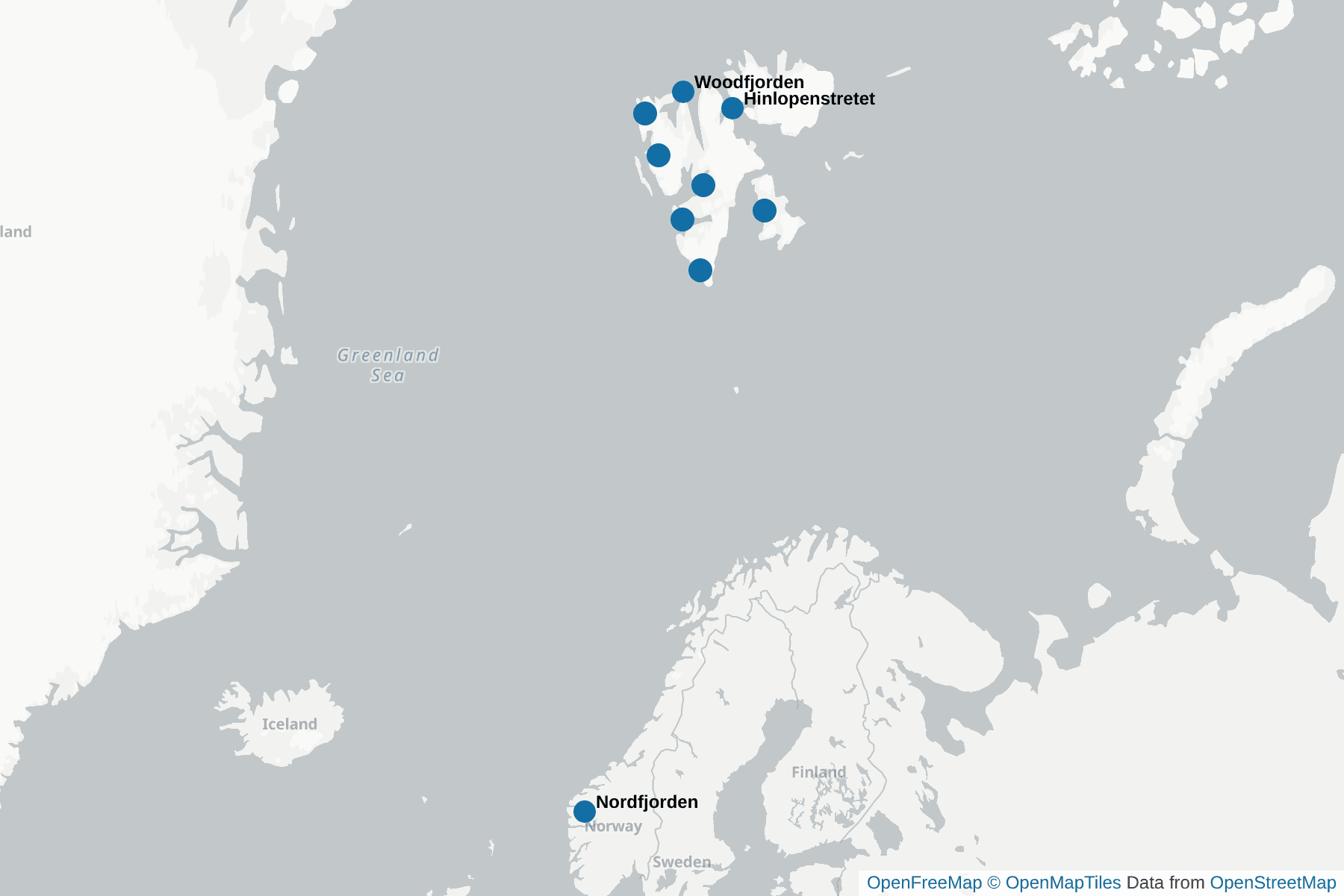
Highlights where the Reindeer can be seen

QuarkExpeditions_Spitsbergen in Depth Arctic
Ahlstrandodden and Bamsebu

These two sites are at the entrance to the southern arm of Bellsund - Van Keulenfjorden. Both sites, and the area between them, are scattered with remains from the Beluga, the white whale, that was hunted for the blubber and skin. There are piles of bleached bones and upturned wooden boats that were left when the area was abandoned in the 1930’s.

Beluga can be seen along the shore here. If you are lucky to encounter them it is poignant with their bleached bones on the shore.

It is popular site for a landing and to walk across the tundra between the two sites, looking for Arctic flowers, Reindeer, Arctic Foxes, and check out some hunter’s cabins and the remains of fox traps.

Also look out for Purple Sandpipers and Red Phalaropes feeding along the shoreline.

G Expedition Arctic Longyearbyen
Arrival at Longyearbyen

The transport hub for Svalbard with the airport. Once just a mining town, it is now involved with tourism and scientific research and has various services, accommodation, shops and cafés, and some interesting museums.

There is also the chance to check out wildlife within town, including Snow Buntings and even reindeer, and to walk along the road through the mudflats to the dog kennels, dodging the Arctic Terns on route. There is an Eider colony next to the kennels and Barnacle Geese and other birds on the mudflats. If you are very lucky, you might see an Ivory Gull near the kennels.

Longyearbyen is the biggest settlement in Svalbard. Seat of the Norwegian administration, it also has the best services and infrastructure in the archipelago. Located deep in the Adventfjord, a sidearm of the Isfjorden (Icefjord), Longyearbyen’s airport can be used all-year round, but its harbor is blocked by ice in winter. Most shops, hotels, restaurants and a hospital are within easy walking distance of the port.

Barentsburg
Barentsburg

An active Russian mining town on the hillside of Grønfjorden, that has fallen on hard times, and it can look bleak and stark.

But it is a great place to walk around with the Soviet architecture. There is a hotel, a souvenir shop, a museum, and recently, with more investment, a brewery. Most of the cruises do not visit, but it is easy to see on a clear day sailing in or out of Isfjorden. It is a popular day trip from Longyearbyen, and you could even stay overnight.

Brucebyen
Brucebyen

Across the bay from Pyramiden, surrounded by some impressive mountains and geology, with a small group of houses and remains of a railway.

These were constructed in 1919 by William Spiers Bruce, the Scottish oceanographer and polar scientist, with the Scottish Spitsbergen Syndicate Ltd. It is a great example of attempts to mine at the start of the 20th century.

Festningen and Russekeila

There is some great tundra to explore along the flat coast on the SW side of Isfjorden, to the east of Kapp Linne.

Festningen, quite close to Barentsburg, is well known for the fossils, including the footprint of a dinosaur in sediments that have been forced by the Earth’s forces into a vertical position. Russekeila is a cultural site from the time the Russian Pomors carried out trapping in this area.

The 14th July Glacier
Fjortende Julibukta

The 14th of July bay and glacier, named by Prince Albert I of Monaco on the Princesse Alice on his oceanographic expeditions to Svalbard from 1898 to 1907.

It is one of the highlights in Krossfjorden, often combining a landing with a Zodiac cruise. Cruising along the impressive glacier front, there are regular calvings with bergs in the bay that attracts birds like kittiwakes. And nearby there are bird cliffs with a colony of Thick-billed Murres (Brünnich’s Guillemot) that also includes Atlantic Puffins. Options for landing (being careful of potential Tsunami waves from calvings) include one of the best spots in the whole of Svalbard for flowers, and even the chance to walk on the side of the glacier.

Albatros Expedition through north atlantic
Freemansundet

This is the sound between Edgeøya and Barentsøya, flat topped islands compared to Spitsbergen, with tundra flats and slopes below higher cliffs of hexagonal pillars.

This is the preferred route to Hinlopenstretet, although the eastern end is usually blocked off by ice in the early season. Whatever the conditions, it is a great place to look out for bears from the high vantage of the ship. Bears often rest on the tundra on either shore, just be aware there are plenty of reindeer that the inexperienced can mistake for a bear in the early season with their whitish coats. It is also an area where whale and seal carcasses can drift ashore, attracting bears. With the tundra there is still the slight influence of the gulf stream. But once through the eastern end the ship is in the high Arctic and a very different landscape, dominated by the polar desert and ice caps.

gnalodden
Gnålodden

Popular landing in Hornsund with spectacular scenery including towering bird cliffs with thousands of breeding Black-legged Kittiwakes and Brünnich’s Guillemots and all the noise (gnål means “nagging” in Norwegian), that attracts Arctic Foxes at the base of the cliff. Geese and reindeer also occur and it is a good location for plants.

Trappers called it Fuglefjell, the location being very popular as a base for hunting bears coming into Hornsund from the key breeding grounds around Hopen in SE Svalbard. The hunter’s cabin at the base of the cliff is famous as the place where the first female trapper stayed, Wanny Wolstead. Even today, staff need to carefully check for bears before going ashore, and sometimes a landing cannot occur if there is a bear on shore.

Hinlopenstretet
Hinlopenstretet

The sound between Spitsbergen and Nordaustlandet in the high Arctic, in contrast to the milder coast of western Spitsbergen. Early in the season it is locked in ice that slowly clears from the south.

The northern end can be blocked by the pack for a while, varying from season to season. Once open, it enables circumnavigation of Spitsbergen, although ice can still drift in on strong currents and block Hinlopenstretet. When Hinlopenstretet is open, but the northern end is still blocked, ships will come into the area, typically sailing along Freemansundet between Edgeøya and Barentsøya, then return.

The area is superb for Zodiac cruises and landings, and can be superb even as a ship cruise. There are plenty of seabirds, the sound can be good for whales, there are various fjords to explore, like the surprisingly arid and desert-like Wahlenbergfjorden, various island groups to explore, like Wahlbergøya, and the chance to experience what is described as the polar desert. Three locations stand out as highlights in whole of Svalbard, the ice cliff Bråsvellbreen, the Walrus Haul out at Torellneset , and the bird cliff at Alkefjellet.

Albatros Expedition high arctic- iceland to svalbard
Hornsund

The fjords in the inner part of Hornsund is superb to explore by ship with the spectacular rugged scenery, including the distinctive and towering peak known as Hornsundtind. The geology is impressive, and make sure to look out for birds, seals, and even Polar bears.

Deeper in the Fjord, there is the impressive and long glacial front of Hornbreen, and there are glacial fronts in Burgerbutka to the north, and Samarinvågen to the south. These locations are also excellent for Zodiac cruising to get close to the glacial fronts (at a safe distance) and look for wildlife.

Amongst the ice floes is a great place to look for Ringed Seals, Bearded Seals, and the Ivory Gull.

Atlantic Walrus (Odobenus r. rosmarus) haul up
Kapp Lee

Located on the NW corner of Edgeøya at the entrance to Freemansundet, Kapp Lee is the location of a Walrus haul out that is also a good location for Reindeer, the chance of Arctic Fox, and great tundra vegetation.

It is also a site of cultural significance with the foundations of a Pomor dwelling and several hunters cabin including a hexagonal shaped hut that is right next to the Walrus haul out. Just above the shoreline on nearby beach are the remains of a Bow Head Whale where the carcass must have drifted ashore long ago. Now, with isostatic rebound (the land slowly rising up after being pushed down under the weight when the whole of Svalbard was under an ice sheet) the bones are a short distance above the shoreline.

Kongsbreen og Tre Kroner
Kongsvegen and Kongsbreen

The inner part of Kongsfjorden is popular for ship cruising and especially Zodiac cruising with the mountain scenery, some impressive glacier fronts, and the chance to explore the ice floes looking for wildlife, and the chance of a bear.

Also keep a look out for Long tailed Jaegers, one of the few places they breed in Svlbard is on the island of Ny London in the middle of Kongsford. A number of lakes and pools in the region can attract a range of waterbirds.

Krossfjorden Spitsbergen
Krossfjorden

The two split fjords that form the inner part of Krossfjorden are popular for ship cruising and Zodiac cruising to enjoy the scenery, the glacier fronts, and to look out for wildlife and the chance of a bear.

There are also several options for landings including Möllerhamna, with a hunter’s cabin painted orange that is known the ‘Lloyds Hotel’. Many cruise ships have visited the site for over 100 years, leaving behind mementoes like signs, graffiti (no longer allowed), and a bar. Sigenhamna is another location where there was a German weather station in World War II.

Disembark & goodbyes
Longyearbyen

Longyearbyen is the biggest settlement in Svalbard. Seat of the Norwegian administration, it also has the best services and infrastructure in the archipelago. Located deep in the Adventfjord, a sidearm of the Isfjorden (Icefjord), Longyearbyen’s airport can be used all-year round, but its harbor is blocked by ice in winter.

Most shops, hotels, restaurants and a hospital are within easy walking distance of the port. One of the most prominent buildings in town is the UNIS center, where several Norwegian universities have joined forces to operate and offer the northernmost higher education to both Norwegian and international students. Adjacent to UNIS, and well worth a visit, is the Svalbard Museum, covering the natural history and exploitation of Svalbard. Remnants of the former mining activity can be seen all around Longyearbyen and even in town.

A range of wildlife can be seen around the town and the mudflats on the road to the dog kennels. There is an Eider colony here and Ivory Gulls can sometimes be seen. If you can dodge the diving Arctic terns, the mudflats attract birds like Barnacle Geese, and a range of waterbirds and shorebirds that are scarce in other parts of Svalbard.

Arctic tern Magdalenefjorden
Magdalenefjorden

One of the most spectacular and most photographed fjords in Svalbard, and with all the pointed peaks it can be understood how Spitsbergen got its name. Very popular for the landing at Gravneset, with the whaler’s graveyard it is named after, with the remains of the blubber ovens from the whaling days.

The tundra is also great for plants and wildlife, from geese to Arctic Terns. Zodiac cruising is a great way to explore the rest of the fjord and to look out for wildlife that includes a huge Little Auk colony in the scree on the northern side (some quite close to the shore), and to look out for seals. As well as Ringed Seals and Bearded Seals there is a spot with Harbour Seals (the most northerly in the World?), and a site where Walrus haul on a sandy beach at the entrance of the fjord to the west of Gravneset. The Waggonwaybreen glacier has been retreating and ships can get quite close to witness carvings, a floating platform on the part of the open fjord that was covered by the glacier just a few years ago. Staff will always be on the lookout for bears that can turn up here.

QuarkExpeditions_ Northwest Passage Arctic Canada
Nordfjorden

There are several deep fjords along the north coast of Isfjorden with glaciers coming down to the bay. These can be popular for Zodiac cruises along the glacial fronts, discover wildlife, and in some places, even to get ashore to walk on a glacier.

Ny Ålesund
Ny Alesund

The World’s northernmost year-round community and a site of cultural importance with layers of history. Originally it was a remote coal mining town, known as Kings Bay, until a serious accident in 1962.

The location meant King’s Bay was the starting point of various historical attempts to reach the North Pole, and the mast for Nobile’s airships can still be seen. Today it is a centre for international Arctic research, with traditional houses of when it was King’s Bay alongside modern bases for various countries. It is great to walk around the town and tourism also plays a role and ships can come alongside at the dock (one of the few docks apart from Longyearbyen and Barentsburg in Svalbard). There are shops, a museum, and the most northerly post office in the World. It is also great for birds, including Barnacle Geese (perhaps the most well studied wild geese in the World), Red-throated Loons on the lake, and the chance of an Ivory Gull by the dog kennels.

Ny London, Svalbard
Ny London

This location is on the island of Blomstrandhalvøya that is in Kongsfjorden and just across the bay from Ny Ålesund. It is the site of an ill-fated attempt to extract the marble deposits by the Northern Exploration Company and the adventurer Ernest Mansfield.

A lot of money and effort was put into the project, but it turned out the marble would shatter as it warmed up! Today there are the remains of the marble quarry and debris from the mine, including wooden huts, and various bits of machinery, including a crane and a rusting steam engine. As well as the cultural remains it is a good place for wildlife, including the elegant Long-tailed Skuas that breed here that are very rare elsewhere in Svalbard, with the Arctic Skua being far more abundant.

Pyramiden
Pyramiden

This Russian mining town that used to be the largest settlement in Svalbard. Abandoned in 1998, it must have been impressive in the 1970s and 1980s, with wide avenues and lawns, Soviet architecture, and lots of families.

Today it is a very eerie and atmospheric, with the mining facilities falling apart over quite a large area, on the flats and the hills above the town. There are the various Soviet era structures and artwork, including the school playground, the cultural center, the food hall, and the most northerly swimming pool in the World (dry now) and bust of Lenin.

There is a hotel, still open, with a bar that you can visit. But you need to go with someone with a rifle, since bears do roam through town! It is also a good place to see Arctic Fox, and one of the most reliable places to see the Ptarmigan, the ‘Arctic’ grouse. The name comes from the shape of the mountain behind the town, which adds to the character of the place.

Puffin Raudfjorden
Raudfjorden

Further around the Northwest coast of Spitsbergen, further to the east, this fjord is often blocked off by the pack ice in the early season before, but is the first area to become free as the pack ice retreats from the NW corner of Spitsbergen.

The mountains in this area are rugged and the coast here may have been the land that Barents saw when he came up with the name of Spitsbergen. The name, ‘red fjord’ comes from the red sandstone in the south and east areas of the fjord. There is a hunter’s wooden cabin at Bruceneset and a cairn for a pioneer that died of scurvy whilst overwintering in 1907/08. The name is for the explorer William S. Bruce, the area named by Prince Albert I of Monaco on the Princesse Alice on his oceanographic expeditions to Svalbard from 1898 to 1907.

Russebukta Svalbard
Russebukta

On the SW coast of Edgeøya, the name means Russian’s Bay from when Pomor hunters were in the area.

This is an area of boggy tundra with numerous lakes that is a great location for a wide range of Svalbard birds and Reindeer in the Søraust-Svalbard Nature Reserve.

Skansbukta
Skansbukta

Remains of a gypsum mine below spectacular and beautiful cliffs. In addition to the cultural remains, including parts of a railway and a barge, it has an interesting flora due to the ‘mild’ location, deep inside Isfjorden.

Nearby cliffs, which go right down to the sea, are eroded into impressive shapes, and can be a great place to explore offshore in a Zodiac, the chance to see various seabirds that breed on the cliffs, with kittiwakes and four auk species including Puffins. It is a popular site for a combined landing and Zodiac cruise, and a ‘sail’ past on boats out from Longyearbyen that are visiting Pyramiden.

Smeerenburgfjorden - Svalbard
Smeerenburgfjorden

This extensive fjord system has impressive scenery and numerous glaciers that is great to explore by ship whilst being on the watch out for bears. It is also an area with lots of history.

Smeerenburg was the base for the Dutch whalers that was known as ‘blubber town’, with the remains of the blubber ovens for those that get ashore. There is also a Walrus haul out that can be observed from the shore, or from a Zodiac if there is a bear nearby (quite often the case here in the NW). Close by is Virgohamna, the site where Andrée set off his ill-fated trip to the North Pole by balloon in 1897, and where Wellman attempted to fly to the pole in the early 1900’s. Today there are the scattered remains of the balloon shed and the aircraft hangar. Special permission is required to land but the remains can be seen from a Zodiac offshore. Smeerenberg was also the location where the Fram appeared after drifting across the Arctic Ocean, stuck in the ice for three years!

G Expedition Arctic Svalbard
Vårsolbukta

On the NW side of Bellsund, this is a huge Little Auk colony amongst the extensive scree on the side of the mountain ridges above the landing beach.

It can be a challenge to get to, and to scout, in case of bears, but it is a stunning wildlife spectacle with thousands of Little Auks wheeling around and calling (sounding like little trolls!). The activity also attracts Arctic Foxes and the tundra, with all the nutrients leaching down, is superb for plants, and to look out for geese and Reindeer.

Along the shore there is the chance of Beluga.

Arctic Beauty - Svalbard - Woodfjorden
Woodfjorden

This large fjord, and the associated Bockfjorden and Liefdefjorden in northern Spitsbergen, becomes accessible as the pack retreats. It is great for ship cruising, enjoying the scenery, and to look out for bears along the extensive coastline.

Flexibility is key with the chance of bears and changing weather conditions, but with plenty of choices in this large fjord complex. Zodiac cruises are popular, including Monacobreen glacier at the end of Liefdelfjorden, and the islands of Andøyane, a great area for a range of birds, including King Eider. There are also options for landings. The large and impressive wooden hut at Mushamna on the NE side of Woodfjorden. The small hunter’s cabin known as the Texas Bar in Liefdefjorden. The ‘thermal spring’ at Jotunkjeldane in Bockfjorden.

Our trips to spot the Reindeer