Polar Tours Logo 1200px full color svg

All Dates & Prices

Trip Type

Antarctica

Arctic

Info

Home

All Dates & Prices

Trip Type

Ship Size

All Ships & How to choose the best

Micro-Cruises

Small Ships

Mid-Sized Ships

Large Ships

Ways to travel

Luxury Cruises

Premium Cruises

Classic Cruises

Discounted Cruises

Polar Expeditions for Solo Travelers

Antarctica

Antarctica

All Dates+Prices

Antarctic Season 2025/2026

Antarctic Season 2026/2027

Info

Antarctica Last Minute Offers

Antarctica Travel Information

Air Cruises: Fly to Antarctica!

Download Our Free Antarctica Guidebook

Weather in Antarctica

Wildlife of Antarctica

Top Destinations

Antarctic Sound & Weddell Sea

Cruises beyond the Antarctic Circle

South Georgia

South Shetland Islands

Travel Styles

Antarctica Luxury Cruises

Cheapest Antarctica Cruises

More Comfort: Antarctica Large Ship Cruises

Small Ship Expedition Cruises to Antarctica

Arctic

Info

Arctic Travel Information

Arctic Trips for Solo Travelers

Download Our Free Arctic Guidebook

Wildlife of the Arctic

Top Destinations

Svalbard

Canadian Arctic

Greenland

Iceland

North Pole

Northern Lights Cruises

Northwest Passage

Travel Styles

Arctic First Class Cruises

Arctic Luxury Cruises

Arctic Small Ship Expedition Cruises

Artic Last Minute Cruises

Discounted Arctic Cruises

Polar Bear Tours

Small Ship Cruises in Svalbard

Artic

All Dates+Prices

Info

Info

FAQ

YouTube: Polar Expert Talks

Our Team

What our travelers say

Activities & Add-Ons

Blog

Free Polar Guidebook

Sustainable Tourism

Travel Insurance for EU + CH Residents

Trips for Solo Travelers

Your Advantages

Why book with us?

Free Video Consultation

All deals in one place

Best Price Guarantee

No Hidden Fees

Unbiased Recommendations

Your money is protected

Contact us

Weekdays from 5:00 to 16:00 EST

$
​
​
$
​
​

Sign up for our Polartours newsletter

Get travel inspiration from Antarctica and the Arctic and receive exclusive discounts.

​
Polar Tours Logo 1200px full color svg

Luxury Cruises

Island Sky

SH Diana

Scenic Eclipse I

Silver Cloud

Silver Explorer

Silver Wind

Ultramarine

Premium Cruises

Douglas Mawson

Freya

Greg Mortimer

Hebridean Sky

Kinfish

Magellan Discoverer

Magellan Explorer

Classic Cruises

50 Years of Victory

G-Expedition

Hans Hansson

Hondius

Janssonius

Kapitan Khlebnikov

MS Balto

Further Links

Best Price Guarantee

Ernest Shackleton

Join our team!

Last Minute Deals

Mandatory Insurance

Packing List

Trips departing from Punta Arenas

Further Information

FAQ

Terms & Conditions

Careers

ventura TRAVEL

Contact Us

🇺🇸 +1 347-493-2978

🇬🇧 +44 20 4571 8661

🇩🇪 +49 30 3119 3691

🇫🇷 +33 1 76 38 06 39

service(at)polartours.com

Contact Form

Weekdays from 5:00 to 16:00 EST

QuarkExpeditions_Spitsbergen Highlights

Arctic Expedition Cruises

A special destination with thriving wildlife and a chance to gaze on the natural wonder that is the Aurora Borealis.

Information about The Arctic

The great Arctic encompasses the northernmost destinations on Earth. From the unparalleled glaciers of Greenland, to the incredible structure of Svalbard and the jaw-dropping volcanic beauty of Iceland, the Arctic offers unique encounters with the natural world at its most rugged and wild.

Embark on an expedition cruise into the heart of the Arctic, where wildlife thrives in abundant waters and immeasurable tundra. Take zodiac cruise rides through pack ice, as you spot curious seals and breaching whales. Experience the vastness of the impressive bird cliffs in Iceland. And, if you're lucky, observe the elusive polar bear and walrus on sea ice near Svalbard.

Immerse yourself in this awe-inspiring world rich in history, fascinating traditional culture, and wildlife that will leave you with unforgettable memories. We offer a wide range of Arctic cruises itineraries that suit all tastes.

Pictures of The Arctic

Albatros Expedition high arctic- iceland to svalbard
+2
Albatros Expedition high arctic- iceland to svalbard

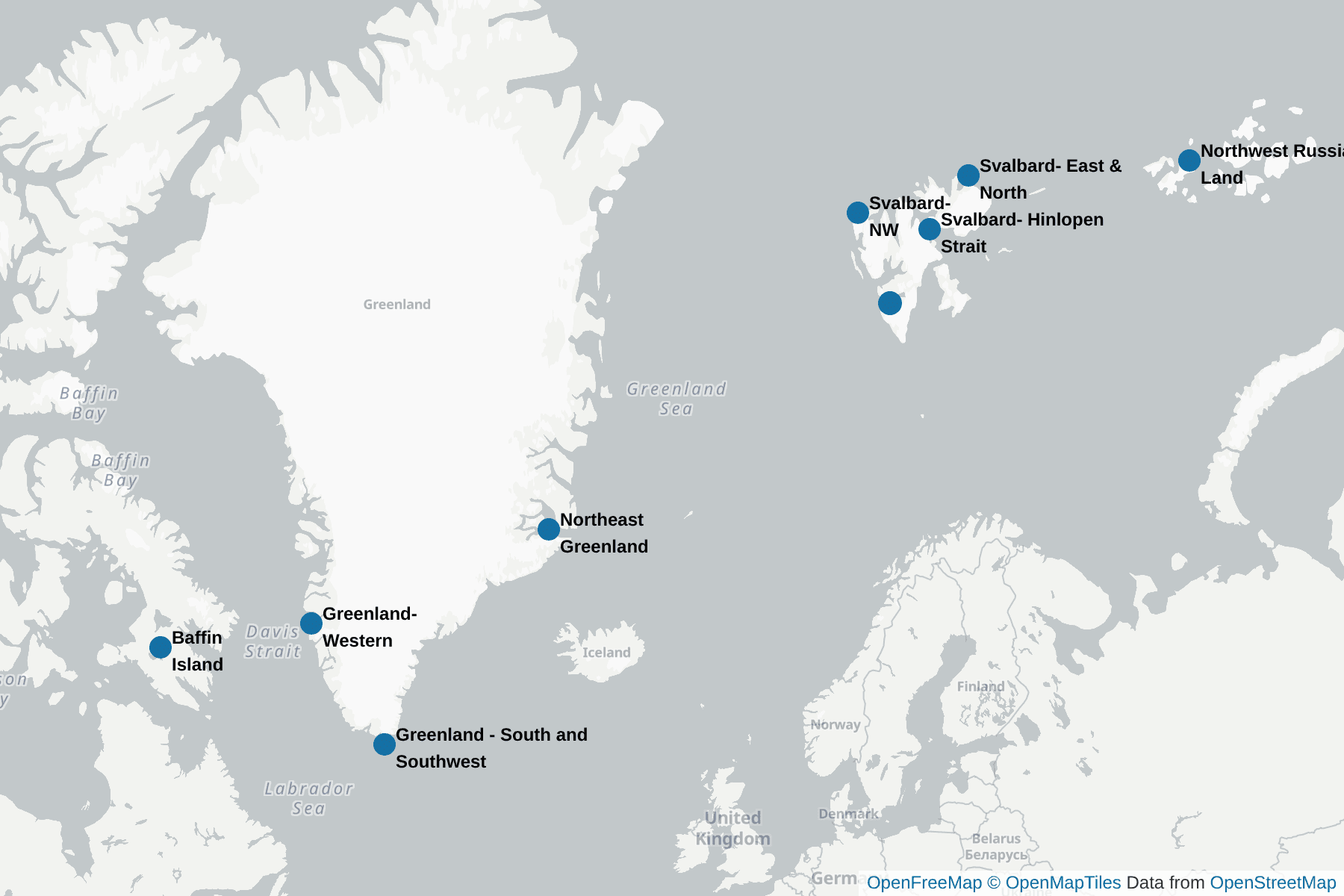
Destinations you will visit in The Arctic

Baffin Bay
Baffin Island
Franz Joseph Land
Northwest Russia and Franz Joseph Land
An Antarctica Cruise on board the G Expedition with Polartours
Svalbard- Hinlopen Strait
Albatros Expedition North West Passage
Northeast Greenland
Svalbard – Store norske leksikon
Svalbard- East & North
G expedition greenland and spitsbergen
Svalbard- NW
Ocean Atlantic Greenland National Park
Greenland - South and Southwest
Southern Spitsbergen
Svalbard- SW
A beautiful late summer day on Svalbard (Spitsbergen) with the most spectacular nature scenery
Svalbard Isfjorden
Ocean Atlantic Greenland National Park
Greenland- Western

Highlights in The Arctic

Tasiilaq
Tasiilaq & Kulusak

Tasiilaq is the largest town in south-east Greenland, close to the mouth of the rugged and long Sermilik Fjord. With the ice sheet just to the west the Sermilik glacier carves numerous icebergs. Kulusak is nearby and with an airport is popular with the short flight from Iceland.

Area good for the landscape, whale watching, the wildlife, and the flora.

G Expedition Arctic Svalbard
Apollonov & Stolichkiy Islands

Small islands in Austria Sound, known for the large herds of Walruses. You will most likely smell them before you see them!

Narsarmijit
Narsarmijit & Tasermiut Fjord

Pretty Greenland village at the southern tip of Greenland that was the easternmost of the Norse settlements during their colonization of Greenland, with remains in the area (most settlements were on the south-west coast).

The fjords are great to explore including Tasermiut Fjord with the largest hanging glacier in southern Greenland, with World challenging big walls for climbing such as Ulamertorsuaq and Nalumasortoq.

North Pole the Ultimate Arctic Adventure
North Pole

The only way to get into the consolidated pack ice is with the icebreakers, and the Russian icebreakers have been sued for expeditions to the North Poke that usually go from Murmansk to the pole via Franz Joseph Land.

Vestfjord
Vestfjord

The most westerly fjord, deep in the Scoresbysund that ‘splits’ into Rodefjord and Føhnfjord around Milneland.

Two large glaciers coming off the icesheet terminate in Vestfjord, Døde Bræ and Vestfjord Glacier, split by a nunatak reaching a height of 2,468 m (8,097 ft). The glaciers can carve so many icebergs it can be a challenge to get into the fjord at times. But still spectacualr scenery at the entrance.

Greenland and Arctic Canada
Dundas Harbour

First built in 1924 as a Canadian outpost on the southeast coast of Devon Island, with concern about sovereignty of this Arctic Archipelago. It was settled several times but finally abandoned with a ‘ghost town’ feel. Tundra is good to explore and to ship cruise the nearby inlet.

Greenland
Ella Island

Located at the mouth of Kempe Fjord in the northern end of King Oscar Fjord. With the larger islands to the east such as Geographical Society Island.

It is in the middle of the King Oscar Fjord and Kaiser Franz Joseph Fjord ‘complex’ that matches Scoresbysund to the south. It is a great area to explore with stunning scenery, often the first Greenland landscape that many cruise ships experience that have come across from Svalbard, and you may even find wolf tracks on walks ashore. But expeditions tend to spend more time in Scoresbysund since the entrance to this fjord system can be blocked off by sea-ice drifting south in the cold southern flowing East Greenland current.

Rypefjord to end up in front at Eielson Glacier
Rypefjord & Terrassepynt

Rugged fjord that comes in from the North-West into Ofjord near Storo island, deep in Scoresbysund.

Great ship and Zodiac cruising with huge icebergs carving from the impressive Eielson glacier at the head of the fjord. Compared to many steep sided coasts in the region there is the chance for a landing at Terrassepynt. To climb up the tundra slope and look down at the fjord and the glacier at the head. Also great for Musk Ox.

Bearded Seal (Erignathus barbatus) the lucky survivor
Torrelneset

The highlight here is the large Walrus haul out on the beach, one of the best in Svalbard.

It is also a great location to land, one of the few locations on Nordaustlandet, and experience the polar desert, and to walk up a series of raised beaches to a viewpoint overlooking Hinlopenstretet.

Kongsbreen og Tre Kroner
Kongsvegen and Kongsbreen

The inner part of Kongsfjorden is popular for ship cruising and especially Zodiac cruising with the mountain scenery, some impressive glacier fronts, and the chance to explore the ice floes looking for wildlife, and the chance of a bear.

Also keep a look out for Long tailed Jaegers, one of the few places they breed in Svlbard is on the island of Ny London in the middle of Kongsford. A number of lakes and pools in the region can attract a range of waterbirds.

Assorted Ice bergs Thule Greenland
Thule & Qannaq

Thule and the town of Qannaq are in the far northwest corner of Greenland on Inglefield fjord.

The fact there is a US military base here just shows how close it is to North America. Ellesmere Island, and the Canadian Arctic, is just across Smith Sound.

Nuuk
Nuuk

Greenland’s largest city and capital that is surrounded by snow-capped mountains, at the mouth of an extensive fjord system. Great to explore the city and the surrounding tundra and fjords, with lovely sunset views from Myggedalen.

Milneland
Milneland

A large and rugged island with steep cliffs, well into SW Scoresbysund that can be circumnavigated with access to several deeper fjord systems with glaciers coming down from the Greenland ice sheet.

Starting from the open sound (the actual area named Scoresbysund) and going in a clockwise direction from the Bear Islands: Ofjord to Storo island, then Rodefjord, then Føhnfjord back to the islands of Denmarkøya. Great ship and Zodiac cruising (even over several days), plus the chance of some landings. Spectacular ship cruising, Greenland at its best and a 'destination' within a destination with numerous highlights.

Much of the area has steep sided fjords, but where there are slopes with tundra, look at for Musk-ox.

Pond Inlet, Nunavut, Canada
Pond Inlet & Mittimatalik

Located in the very northeast of Baffin Island, facing across to Bylot Island. There is the Inuit community and it is also a popular location and base for wildlife tours, including looking for Narwhal along the ice edge before it retreats.

Arctic tern Magdalenefjorden
Magdalenefjorden

One of the most spectacular and most photographed fjords in Svalbard, and with all the pointed peaks it can be understood how Spitsbergen got its name. Very popular for the landing at Gravneset, with the whaler’s graveyard it is named after, with the remains of the blubber ovens from the whaling days.

The tundra is also great for plants and wildlife, from geese to Arctic Terns. Zodiac cruising is a great way to explore the rest of the fjord and to look out for wildlife that includes a huge Little Auk colony in the scree on the northern side (some quite close to the shore), and to look out for seals. As well as Ringed Seals and Bearded Seals there is a spot with Harbour Seals (the most northerly in the World?), and a site where Walrus haul on a sandy beach at the entrance of the fjord to the west of Gravneset. The Waggonwaybreen glacier has been retreating and ships can get quite close to witness carvings, a floating platform on the part of the open fjord that was covered by the glacier just a few years ago. Staff will always be on the lookout for bears that can turn up here.

hall island
Hall Island

The popular site to visit here is Cape Tegetthoff, named after the ship used in the Austro-Hungarian North Pole expedition to find the North-East Passage from 1872 to 1874, partially exploring Franz Josef Land. There are interesting geological pinnacles, tundra, wildlife, and remains of the hut used by Wellman to winter in 1898 before his failed attempt to get to the North Pole.

QuarkExpeditions_ Canada Epic High Arctic
Cambridge Bay

Situated on the SE coast of Victoria Island (the 8th largest in the World), and the largest community on the Island. As well as the community focus there is the history of the area

The first Europeans to reach Cambridge Bay were overland explorers led by Thomas Simpson in 1839; searching for the Northwest Passage and crossing the sea ice to Cambridge Bay by foot. Another overland expedition was led by John Rae who reached Cambridge Bay in 1851. The first ship to reach the bay was HMS Enterprise under Richard Collinson who wintered there in 1852/53. Both Rae and Collinson were searching for Franklin's lost expedition.

Tasiilaq
Qassimiut

Richly coloured houses in this small village situated on a small island close to the ocean. Behind there is a backdrop of vertical mountains and deep fjords.

Greenland and Arctic Canada
Beechey Island

Key historical site where Franklin spent his first winter before the Erebus and Terror vanished to the outside World.

Made very sombre with the graves of three of Franklin’s men, and others, plus later memorials. Situated on the very southwest corner of Devon Island, separated by Barrow Strait, it is at a key ‘crossroad’ in the northwest Passage and was the main base in the search for Franklin.

This remote location is a key destination for everyone that visits the NW passage, with the main focus on the location, rather than wildlife, but offshore can be good for Beluga.

Hinlopenstretet
Hinlopenstretet

The sound between Spitsbergen and Nordaustlandet in the high Arctic, in contrast to the milder coast of western Spitsbergen. Early in the season it is locked in ice that slowly clears from the south.

The northern end can be blocked by the pack for a while, varying from season to season. Once open, it enables circumnavigation of Spitsbergen, although ice can still drift in on strong currents and block Hinlopenstretet. When Hinlopenstretet is open, but the northern end is still blocked, ships will come into the area, typically sailing along Freemansundet between Edgeøya and Barentsøya, then return.

The area is superb for Zodiac cruises and landings, and can be superb even as a ship cruise. There are plenty of seabirds, the sound can be good for whales, there are various fjords to explore, like the surprisingly arid and desert-like Wahlenbergfjorden, various island groups to explore, like Wahlbergøya, and the chance to experience what is described as the polar desert. Three locations stand out as highlights in whole of Svalbard, the ice cliff Bråsvellbreen, the Walrus Haul out at Torellneset , and the bird cliff at Alkefjellet.

IJsberen op Spitsbergen
Kvitøya

Translating as ‘White Island’, located in the extreme NE of Svalbard it is both a bleak and a beautiful location with most of the island covered by an ice cap, with one rocky peninsula at the eastern end.

Few cruise ships get here, and there are years when it remains in the grip of the pack ice the whole season. It is also the location where the remains of Andrée and his two companions were found, along with the journal, and a tin box containing photographic films. They set off on their ill-fate balloon expedition to the North Pole in 1897, then disappeared, a mystery for decades until their remains were found on Kvitøya, 33 years later in 1930, an indication of the remoteness of the island and the scarcity of vessels that sailed through the area or landed. With a memorial to the expedition, and just to step ashore, it is a unique landing. But this is often unlikely with changing weather conditions, where the fog can come in quickly, and the fact that that bears are often found here. It is still a great location for a Zodiac cruise, weather permitting, to explore the rocky eastern end, look out for Walrus and bears, and pause to think of the fate of Andrée.

Smeerenburgfjorden - Svalbard
Smeerenburgfjorden

This extensive fjord system has impressive scenery and numerous glaciers that is great to explore by ship whilst being on the watch out for bears. It is also an area with lots of history.

Smeerenburg was the base for the Dutch whalers that was known as ‘blubber town’, with the remains of the blubber ovens for those that get ashore. There is also a Walrus haul out that can be observed from the shore, or from a Zodiac if there is a bear nearby (quite often the case here in the NW). Close by is Virgohamna, the site where Andrée set off his ill-fated trip to the North Pole by balloon in 1897, and where Wellman attempted to fly to the pole in the early 1900’s. Today there are the scattered remains of the balloon shed and the aircraft hangar. Special permission is required to land but the remains can be seen from a Zodiac offshore. Smeerenberg was also the location where the Fram appeared after drifting across the Arctic Ocean, stuck in the ice for three years!

Icebergs at Cape York,Greenland
Cape York

In northwest Greenland in Melville Bay, the ice sheet comes right down to the coast, separating the very northwest part of Greenland from the rest of western Greenland.

Cape York is one of the first locations on this northwest coast that has tundra and lakes to explore. The mountains and icebergs match this remote location that, in many ways, has far more of a link with the Canadian Arctic, rather than Greenland.

It is one of the most important locations in NW Greenland for breeding seabirds and it can be good for marine mammals. Including traditional hunting ground, whalers and explorers have also visited the area, and the family of Admiral Robert Peary's family placed a monument in honour of his explorations on the cape.

Nice area to explore the tundra and enjoy the magnificent views.

Looking west towards the island
Prince Leopold Island

This island is in a key location in Lancaster Sound at the junction of Prince Regent Inlet and Barrow Strait, off the northwest coast of Somerset Island. It has some really impressive and steep seabird cliffs that is one of the most important sites in the Canadian Arctic and a bird sanctuary.

Also good area to look for marine mammals and other Arctic wildlife.

Ivory Gull, Wilczek Island, Franz Josef Land, Russia, August 2017
Wilczek Island

The Admiral Tegetthoof, caught in the ice off Novaya Zemlya in 1872 came to a halt off this tiny island for the winter of 1873-74. They explored the area and there is the grave of Otto Krisch, the one expedition team member that died.

One of the largest islands on the SE side of the archipelago. Mapped by Payer in 1874 and visited by the Wellman expedition in 1898-99. It was the overwintering site of Bentsen and Bjorvik on the Wellman expedition, attempting to set up an advanced cache for Wellman’s attempt (he overwintered at Cape Tegetthoff) on the North Pole. Bentsen died here and the grave can be seen and the remains of the cabin.

Atlantic Walrus (Odobenus r. rosmarus) male
Storøya

This island is off the NE coast of Nordaustlandet and there is a very large Walrus colony, with lots of mothers with young.

Although it is almost impossible to get ashore with the restrictions and all the Walrus, the terrain, and the chances of bears, it is popular for a Zodiac cruise for ships doing a circumnavigation of the whole archipelago.

Ilulissat
Ilulissat & Disko Bay

One of the key highlights in Greenland with the chance to witness Ilulissat Kangerlua, one of the most active glaciers in the World. Either overlooking the iceberg choked fjord from a viewpoint on a short walk from town, or Zodiac cruising the outer fjord past a ‘wall’ of huge icebergs jumbled together. The walks across the tundra to the viewpoint can be a chance to see various Arctic birds whilst there is the chance to experience of life in town and the busy fishing port. There is also the chance of whale watching in Disko Bay.

Skansbukta
Skansbukta

Remains of a gypsum mine below spectacular and beautiful cliffs. In addition to the cultural remains, including parts of a railway and a barge, it has an interesting flora due to the ‘mild’ location, deep inside Isfjorden.

Nearby cliffs, which go right down to the sea, are eroded into impressive shapes, and can be a great place to explore offshore in a Zodiac, the chance to see various seabirds that breed on the cliffs, with kittiwakes and four auk species including Puffins. It is a popular site for a combined landing and Zodiac cruise, and a ‘sail’ past on boats out from Longyearbyen that are visiting Pyramiden.

QuarkExpeditions_ Canada Epic High Arctic
Uunartoq

Uninhabited island on the south-west coast close to the southern tip of Greenland that overlooks icebergs and can be a good spot for Humpback Whales. There are also hot springs nearby, the remains of Innuit settlements, and the chance to see White-tailed Eagle.

G Expedition Arctic Svalbard
Vårsolbukta

On the NW side of Bellsund, this is a huge Little Auk colony amongst the extensive scree on the side of the mountain ridges above the landing beach.

It can be a challenge to get to, and to scout, in case of bears, but it is a stunning wildlife spectacle with thousands of Little Auks wheeling around and calling (sounding like little trolls!). The activity also attracts Arctic Foxes and the tundra, with all the nutrients leaching down, is superb for plants, and to look out for geese and Reindeer.

Along the shore there is the chance of Beluga.

Franz Josef Land
Rudolf Island

The most northerly island in Franz Joseph Land, and in the whole of Eurasia - Cape Fligely, 911km/566mi from the North Pole, at 81o 52’N. Various expeditions came here, some over winter, with at least two explorers buried here - Sigurd Myhre (1904?) and Georgiy Sedov (1914). A meteorological station was setup in 1932 and as a Soviet airbase in the high Arctic. Now there are decaying buildings covered in snow.

QuarkExpeditions_Spitsbergen in Depth Arctic
Akseløya

A long narrow island of hard bedrock at the entrance to Van Mijentfjorden, the northern fjord arm of Bellsund. It is popular for a Zodiac cruise around the island and through the narrow Mariasundet, with the strong currents that attract seabirds.

There is the chance of landing to explore the geology, but with lots of scouting first to make sure there is not a hidden bear. The surrounding mountains provide some spectacular scenery and some impressive geology. But few cruise ships go further into this deep fjord, preferring to do landings in Bellsund, and to ship cruise into Hornsund.

Kangilinnguit
Kangilinnguit

The main Danish naval base in Greenland, plus various quarries in the region, with interesting geology, and the ‘ghost’ mining town of Ivittut. Arsuk Fjord is an attractive fjord to explore with a tidewater glacier in south-west Greenland, and for Musk Ox (introduced in SW Greenland), White-tailed Eagles and other wildlife.

The 14th July Glacier
Fjortende Julibukta

The 14th of July bay and glacier, named by Prince Albert I of Monaco on the Princesse Alice on his oceanographic expeditions to Svalbard from 1898 to 1907.

It is one of the highlights in Krossfjorden, often combining a landing with a Zodiac cruise. Cruising along the impressive glacier front, there are regular calvings with bergs in the bay that attracts birds like kittiwakes. And nearby there are bird cliffs with a colony of Thick-billed Murres (Brünnich’s Guillemot) that also includes Atlantic Puffins. Options for landing (being careful of potential Tsunami waves from calvings) include one of the best spots in the whole of Svalbard for flowers, and even the chance to walk on the side of the glacier.

Atlantic Walrus (Odobenus r. rosmarus) male
North coast - Nordaustlandet

With most of the island under the icecaps of Austfonna and Vestfonna, this rugged coastline is not covered by the ice cap, including Kapp Platten, but few ships visit this remote coast, preferring to explore Sjuøyane.

Cape Flora, Franz Josef Land/Russian Arctic National Park
Northbrook Island

One of the most southerly islands, in the SW. A number of expeditions visited Cape Flora between 1880 and 1929, some setting up bases and winter quarters, including the Jackson-Harmsworth expedition of 1894-97. There are still artifacts and remains visible. Cape Barents, was also visited by several expeditions.

Cape Flora is also famous for where, on 17th June 1896, Jackson spotted two men heading towards his base, and asked – “Are You Nansen?”!

Narwhal
Bellot Strait

Narrow strait separating Somerset Island to the north from Murchison Promontory of Boothia Peninsula to the south, the northernmost part of mainland America.

The 2km (1.2 mi) wide and 25 km (16 mi) strait connects the Gulf of Boothia, Prince Regent Inlet, and Brentford Bay to the east with Peel Sound and Franklin Strait to the west. It became a strait on ‘one’ of the NW passage routes. On a map of the Canadian Arctic, unless you look in detail, it is easy to assume the Boothia Peninsula and Somerset Island is one peninsula. In many ways, with Bellot Strait locked in ice much of the year, it is like the peninsula. Since it is so narrow, it can be a place to look for Narwhal, and, along the shore, Polar Bear, or even wolf.

Uummannaq
Karrat Fjord and Upernavik

Karrat Fjord, towards the north end of the Uummannaq Bay system, is a great fjord to explore with icebergs, rugged mountains, blue fjords, with the chance to walk on the tundra and look for wildlife. Various species can be seen but others can be elusive due to the proximity of Upernavik.

Upernavik, on the island of the same name, is a very pretty town on the slopes of the island, surrounded by magnificent scenery, at the entrance to the local fjord systems. As well as the colourful houses there is the most northerly 'open air' museum in the World. It also boasts to have the World's largest bird cliffs nearby.

There are a a few settlements further north before the ice sheet comes right down to the coast in Melville Bay between western Greenland and the very NW tip and Thule.

Greenland fjord
Rodefjord and Rode island

Spectacular fjord on western side of Milne Island, red rocks contrasting with huge white icebergs floating down the fjord.

As well as ship and Zodiac cruising there is the chance to go ashore on Rode island - and climb to the top and look down on an iceberg graveyard in the red terrain. Many icebergs drift down from Vestfjord. Awesome!

Uummannaq
Uummannaq

Town on small island of the same name with a prominent peak at the entrance of Uummannaq Fjord.

Photogenic location for the town, the largest north of Ilulissat, with a museum and the chance to experience a Greenland community. The fjords great for the scenery and icebergs and whale watching. In the region is Qilakitsaq, where there is a site with Innuit burial remains.

Ny Ålesund
Ny Alesund

The World’s northernmost year-round community and a site of cultural importance with layers of history. Originally it was a remote coal mining town, known as Kings Bay, until a serious accident in 1962.

The location meant King’s Bay was the starting point of various historical attempts to reach the North Pole, and the mast for Nobile’s airships can still be seen. Today it is a centre for international Arctic research, with traditional houses of when it was King’s Bay alongside modern bases for various countries. It is great to walk around the town and tourism also plays a role and ships can come alongside at the dock (one of the few docks apart from Longyearbyen and Barentsburg in Svalbard). There are shops, a museum, and the most northerly post office in the World. It is also great for birds, including Barnacle Geese (perhaps the most well studied wild geese in the World), Red-throated Loons on the lake, and the chance of an Ivory Gull by the dog kennels.

Gjoa Haven, Nunavut
Gjoa Haven

Situated on the SE side of King William Island it is the location where the Norwegian explorer Roald Amundsen and his crew spent some time on his route through the Northwest Passage.

In October 1903 he put Gjøa into a natural harbour on the southeast coast of King William Island. He stayed there for nearly two years, learning from the local Netsilik Inuit, and the skills to live off the land and travel efficiently in the Arctic environment. This knowledge proved to be vital for Amundsen's later successful exploration to the South Pole. He also explored the Boothia Peninsula, searching for the exact location of the North Magnetic Pole. Today there is a community at Gjoa Haven and a popular landing for cruise ships. Permanent European-style settlement started in 1927, as a Hudson's Bay Company trading outpost. The settlement attracted the traditionally nomadic Inuit people as they adapted a more settled lifestyle. By 2016 the population was 1,324.

Nordvestfjord. East Greenland
Nordvestfjord

Stunning narrow and steep sided fjord that comes down from the north-west, deep in Scoresbysund, Fjord fed by several glaciers including the Daugaard-Jensen Glacier with massive icebergs floating down the fjord. Great ship cruising and excellent Zodiac cruising amongst the huge icebergs.

There is the chance of seeing seals, and, if you are very lucky, a seabird, but bear in mind they are quite shy. Although the location is a long way from Ittoqqortoormiit, hunters do get into the remoter regions of the fjord system, and it means wildlife can be be wary.

Just before reaching the mouth of the fjord there are some areas of tundra that can be good for Musk-Ox.

Hekla Havn
Føhnfjord

Sheer sided fjord on the south side of Milneland. Great ship cruising, often as part of the circumnavigation of Milneland.

Denmarkøya, on the south-east side of Milne Island, is the location of a group of small islands with landing potential at the end of Føhnfjord, at a position between the deeper fjord systems and the open ‘bay’ of Scoresbysund. The popular landing here is Hekla Havn, named after the expedition ship used by Carl Ryder when the expedition explored NE Greenland from 1891 to 92. As well as the hut remains from the expedition, there are older Innuit remains, as well as good tundra walks, wildlife, and some great geology.

Puffin Raudfjorden
Raudfjorden

Further around the Northwest coast of Spitsbergen, further to the east, this fjord is often blocked off by the pack ice in the early season before, but is the first area to become free as the pack ice retreats from the NW corner of Spitsbergen.

The mountains in this area are rugged and the coast here may have been the land that Barents saw when he came up with the name of Spitsbergen. The name, ‘red fjord’ comes from the red sandstone in the south and east areas of the fjord. There is a hunter’s wooden cabin at Bruceneset and a cairn for a pioneer that died of scurvy whilst overwintering in 1907/08. The name is for the explorer William S. Bruce, the area named by Prince Albert I of Monaco on the Princesse Alice on his oceanographic expeditions to Svalbard from 1898 to 1907.

Rypefjord to end up in front at Eielson Glacier
Eqi Glacier

“The calving glacier”– is about 50 miles north of Ilulissat. It is also a location to get onto the ice sheet, and for vessels to get closer to a carving glacier. Also good for whales.

Franz Joseph Land. Heiss island.
Cheysa Island

Krenkel station, a Soviet rocket-launching site was established here in the 1957-58 Geophysical Year, becoming the largest in the archipelago. It closed in the year 2000, with decaying buildings, wreckage, remains of rocket debris, and leaking fuel tanks. A small base was re-stablished in 2005, with plans to revive the site.

Greenland
Blomsterbukta

‘Flower Bay’, a great walk along a gulley to a lake at Blomsterbogten and to explore the tundra for flowers and wildlife, plus a hunter’s cabin. Part of the King Oscar Fjord system it is often combined with a visit to Ella Island in the same day.

QuarkExpeditions_Jewels of the Russian Arctic
Alger Island

Camp Ziegler on Alger Island was one of the camps used by the Fiala-Ziegler Polar Expedition of 1903-1905. This expedition failed in its ultimate goal to reach the North Pole. The expedition crew sought refuge at Camp Ziegler after repeated unfavorable events caused their mission to halt, mostly from extreme weather. Today the huts are in ruins, but one of the best preserved in the area.

Polar Bears near the North Pole
Victoria Island

The most westerly of the group, and, like Kvitoya on Svalbard to the west, it is covered by an ice dome. Visited by expedition cruise ships sailing between the two archipelagos. There are two small ice free (almost gravel) areas to land on the wets and north sides – with a decaying weather station at the latter.

Croker Bay, Nunavut, Canada
Radstock Bay

Situated close to the southwest corner of Devon Island with Viscount Melville Sound nearby.

Great ship cruising in a location close to where Lancaster Sound splits into a myriad of channels that made the exploration of the northwest passage so challenging.

Qaqortoq, Greenland
Narsarsuaq & Qaqortoq

This area of deep fjords and lush scenery was probably the area where that the Vikings came up with the name of Greenland, and where first church in the New World was built.

Icebergs contrast with the verdant landscape that is great explore. Qaqortoq is South Greenland’s largest town with lots of colourful houses. It is also a good area to see White-tailed Eagles and other Greenland wildlfe.

Franz Joseph Land
Jackson Island

One of the north islands in Franz Joseph land. Jackson landed at Cape Mill in 1895, and Nansen and Johansen overwintered (1895-96) at Cape Norway after attempting to get to the North Pole after leaving the Fram. But they did not encounter Jackson until summer 1896.

Albatros Expedition high arctic- iceland to svalbard
Hornsund

The fjords in the inner part of Hornsund is superb to explore by ship with the spectacular rugged scenery, including the distinctive and towering peak known as Hornsundtind. The geology is impressive, and make sure to look out for birds, seals, and even Polar bears.

Deeper in the Fjord, there is the impressive and long glacial front of Hornbreen, and there are glacial fronts in Burgerbutka to the north, and Samarinvågen to the south. These locations are also excellent for Zodiac cruising to get close to the glacial fronts (at a safe distance) and look for wildlife.

Amongst the ice floes is a great place to look for Ringed Seals, Bearded Seals, and the Ivory Gull.

Ny London, Svalbard
Ny London

This location is on the island of Blomstrandhalvøya that is in Kongsfjorden and just across the bay from Ny Ålesund. It is the site of an ill-fated attempt to extract the marble deposits by the Northern Exploration Company and the adventurer Ernest Mansfield.

A lot of money and effort was put into the project, but it turned out the marble would shatter as it warmed up! Today there are the remains of the marble quarry and debris from the mine, including wooden huts, and various bits of machinery, including a crane and a rusting steam engine. As well as the cultural remains it is a good place for wildlife, including the elegant Long-tailed Skuas that breed here that are very rare elsewhere in Svalbard, with the Arctic Skua being far more abundant.

Greenland and Baffin Bay
Peel Sound

This long sound separates Somerset Island on the east from Prince of Wales Island on the west. To the north it opens onto Parry Channel. To the south, at the mouth the Bellot Strait, it merges with Franklin Strait.

Sir John Franklin passed through the strait in 1846, an unseasonably warm summer, since typically Peel Sound is frozen. The east side of Peel Sound was traced by James Clark Ross in 1849, searching for Franklin, and in 1858 Francis Leopold McClintock tried to penetrate it and was blocked by ice. Even today cruise ships attempting the NW passage prefer the Bellot Strait route compared to Peel Sound.

pause for reflection
Etah

At the very northern end of Baffin Bay and the very northwest of Greenland, Etah looks across the Nares Strait to Ellesmere Island, the area usually frozen from October to July.

The area was the crossing point to Greenland for cultures 4,400 and 2,700 years ago, the Thule culture migrants less than a thousand years ago, and the point of the last migration of the Inuit from Baffin Island reached the coast of Greenland in 1865 Etah was also a starting point for various expeditions attempting to get to the North Pole.

Today the channel, when frozen, continues to be a crossing point for wildlife from Canada to Greenland, even Wolverine get across. Etah used to be the most-northerly populated settlement in the world, but it was abandoned (Inuit moving south to Pituffik) due to the harsh conditions.

Arctic Beauty - Svalbard - Woodfjorden
Woodfjorden

This large fjord, and the associated Bockfjorden and Liefdefjorden in northern Spitsbergen, becomes accessible as the pack retreats. It is great for ship cruising, enjoying the scenery, and to look out for bears along the extensive coastline.

Flexibility is key with the chance of bears and changing weather conditions, but with plenty of choices in this large fjord complex. Zodiac cruises are popular, including Monacobreen glacier at the end of Liefdelfjorden, and the islands of Andøyane, a great area for a range of birds, including King Eider. There are also options for landings. The large and impressive wooden hut at Mushamna on the NE side of Woodfjorden. The small hunter’s cabin known as the Texas Bar in Liefdefjorden. The ‘thermal spring’ at Jotunkjeldane in Bockfjorden.

Floating Ice from the Brasvellbreen Glacier
Austfonna and Bråsvellbreen

The ice cliff here is so impressive it features in the opening credits of The Frozen Planet. It is where the massive ice cap of Austfonna, covering 58% of Nordaustlandet, meets the sea, and the third largest ice cap in the World.

The ice cliff is about 180km long, apart from few rocky out¬crops, and roughly 24m high, with a series of waterfalls along the length when it is warmer. The ice cliff is routinely referred to as Bråsvellbreen, but it is the huge glacier streaming out of Austfonna. It often surges forward and is known as the Sudden Swell Glacier. The section at the southern end of Hinlopenstretet is the most accessible, often as a combined ship cruise and a Zodiac cruise, and it is simply breath taking, a bit like the ice wall in the Game of Thrones!

There is also the chance to check out wildlife on the ice floes and the bergy bits.

Krossfjorden Spitsbergen
Krossfjorden

The two split fjords that form the inner part of Krossfjorden are popular for ship cruising and Zodiac cruising to enjoy the scenery, the glacier fronts, and to look out for wildlife and the chance of a bear.

There are also several options for landings including Möllerhamna, with a hunter’s cabin painted orange that is known the ‘Lloyds Hotel’. Many cruise ships have visited the site for over 100 years, leaving behind mementoes like signs, graffiti (no longer allowed), and a bar. Sigenhamna is another location where there was a German weather station in World War II.

Mt. Pandebrasken on Skjoldungen Island, Greenland
Skjoldungen

Large Island, mid-way along the south-east coast, in an area with numerous fjords coming down from the icecap, and some of the best landscapes in SE Greenland.

Uninhabited today, it was used by nomadic people for thousands of years with the remains of Inuit dwellings here. A harsh area to survive in, the Vikings never settled this stretch of coast. Tidewater glaciers calve into the fjords for great ship and Zodiac cruising.

Greenland and Arctic Canada
King William Island

The island (the 61st-largest island in the world and Canada's 15th-largest island) and the surrounding area was the region where the Erebus and Terror ended up.

It is now known the two ships became stranded in 1846 when frozen in the sea ice northwest of the island. After abandoning the two ships, most of the crew died from exposure and starvation as they attempted to walk south near the western coastline. Two of Franklin's men were buried at Hall Point on the island's south coast. It wasn't until June 29, 1981, that researchers finally had luck. A team led by Canadian archaeologist Owen Beattie, found 31 pieces of human bone fragments on the southern tip of the island, called Booth Point. On September 9, 2014 the Victoria Strait Expedition located the wreck of HMS Erebus. The HMS Terror, was found in 2016 in Terror Bay, off the south-west coast of King William Island.

The area also played an important for the Norwegian explorer Roald Amundsen on the expedition through the Northwest Passage, spending nearly two years with his ship on the SE coast at what is now known as Gjoa Haven. The island is separated from the Boothia Peninsula by the James Ross Strait to the northeast, and the Rae Strait to the east. To the west is the Victoria Strait and beyond it Victoria Island. Within the Simpson Strait, to the south of the island, then the Adelaide Peninsula, part of mainland Canada. Queen Maud Gulf lies to the southwest.

Barentsburg
Barentsburg

An active Russian mining town on the hillside of Grønfjorden, that has fallen on hard times, and it can look bleak and stark.

But it is a great place to walk around with the Soviet architecture. There is a hotel, a souvenir shop, a museum, and recently, with more investment, a brewery. Most of the cruises do not visit, but it is easy to see on a clear day sailing in or out of Isfjorden. It is a popular day trip from Longyearbyen, and you could even stay overnight.

High mountains separate Itilleq, Greenland, from Kangerlussuaq Fjord.
Sissiut and Itilleq

Near the mouth of Kangerlussuaq fjord is the larger town of Sissiut (2nd largest after Nuuk). Further south is the small and traditional village of Itilleq with good mountains and tundra nearby.

Ross Fort
Fort Ross

Fort Ross is an abandoned former trading post on Somerset Island. First established in 1937 by the Hudson's Bay Company, it was only operational to 1948, as severe ice conditions in the surrounding waters made the site hard to reach and economically unviable.

It is interesting to visit a Hudson’s Bay Company hut and to contemplate the location. It is situated at the eastern end of Bellot Strait on a south-eastern peninsula of Somerset Island, a key location in the northwest Passage. Also good for a rage of high arctic species.

QuarkExpeditions_ Northwest Passage Arctic Canada
Nordfjorden

There are several deep fjords along the north coast of Isfjorden with glaciers coming down to the bay. These can be popular for Zodiac cruises along the glacial fronts, discover wildlife, and in some places, even to get ashore to walk on a glacier.

Purple Sandpiper (Calidris maritima) summer plumage adult
Sjuøyane

A series of hard granite islands that translates as seven islands, islands that are to the north of Nordaustlandet. Being the furthest north in the whole of Svalbard, the islands can remain in the pack ice for much of the year.

Walrus can be seen throughout the area, with at least one popular landing at a haul out. There are plenty of seabirds, and the chance of a bear resting somewhere on one of the islands, sometimes several bears, understandable with the location. With the myriad of islands it is very popular to explore by Zodiac and the area also has important ties to polar exploration. Many of the locations were named after the English North Pole expeditions led by Phipps (1773) and Parry (1827), including Neslonøya, after a certain young midshipman! Not that long ago the whole area could be trapped in ice throughout the year and just to the east was the area where Nobile’ airship, the Italia, crashed onto the ice, with a huge rescue effort.

Brucebyen
Brucebyen

Across the bay from Pyramiden, surrounded by some impressive mountains and geology, with a small group of houses and remains of a railway.

These were constructed in 1919 by William Spiers Bruce, the Scottish oceanographer and polar scientist, with the Scottish Spitsbergen Syndicate Ltd. It is a great example of attempts to mine at the start of the 20th century.

Ittoqqortoormiit (Greenland)
Ittoqqortoormiit

Close to the entrance of Scoresbysund and the only community on the NE coast.

This small community is one of the remotest in the World, set up by Denmark (with Greenlanders brought in from other parts of Greenland) to mark sovereignty, with the concern (at the time) that emerging nation of Norway might make a claim with hunters visiting the area.

It is the one chance to visit and experience a community in NE Greenland.

Two Seabirds
Coburg Island

Between Ellesmere Island and Devon Island at the entrance to Jones Sound.

It is part of the Nirjutiqavvik National Wildlife Area and Cambridge Point, with spectacular cliffs that are an important location for breeding seabirds including black guillemot, black-legged kittiwake, glaucous gull, northern fulmar, and thick-billed murre. Offshore waters are also good for marine mammals.

QuarkExpeditions_ Spitsbergen Photography: In Search of Polar Bears
Isbjørnhamna

Site of a Polish research base on NW side of Hornsund. A few cruises get the chance to visit the base and to go up to the Little Auk colony.

Arctic Beauty - Svalbard - Woodfjorden
Arctic Bay

On Admiralty Inlet on the very northwest side of Baffin Island.

Named after the whaling ship, the Arctic, in 1872, it is the site of quite a large community (mainly Inuktitut) called Ikpiarjuk, and a popular location to visit for expedition cruise ships. There is a museum and Ikpiarjuk a good place to learn about the culture. The area is great to ship cruise and explore for wildlife.

Little Auk / Dovekie (Alle a. alle)
Fuglesongen

The views of NW Spitsbergen, the land of the pointed peaks, is impressive from this area, once it is free of ice. Fuglesongen means ‘bird song’ and thousands of Little Auks breed here, flying around in huge ‘wheels’ of birds and sounding like little trolls!

A few determined groups make a landing here, but it needs calm conditions, sticking out on the NW tip of Spitsbergen. But is still an impressive site to witness for ships that sail between Fuglesongen and Klovningen. There is no land to the north, towards the pole, the area often covered in the pack ice at the start of the season.

Festningen and Russekeila

There is some great tundra to explore along the flat coast on the SW side of Isfjorden, to the east of Kapp Linne.

Festningen, quite close to Barentsburg, is well known for the fossils, including the footprint of a dinosaur in sediments that have been forced by the Earth’s forces into a vertical position. Russekeila is a cultural site from the time the Russian Pomors carried out trapping in this area.

gashamna
Gåshamna

Historical site on SW side of Hornsund with the remains from the days of whaling and overwintering Russian and Norwegian trappers.

Gåshamna was also the site of the Swedish/Russian Arc of Meridian Expedition from 1898 to 1902, one of the first international research expeditions in the Arctic. In addition to the cultural remains, there is beautiful tundra with the Arctic flora.

Polar Bears near the North Pole
Nansen fjord

Isolated fjord, is to the north of the Arctic Circle, and isolated between Scoresbysund further to the north, and the numerous fjords of the SE coast.

The ice sheet comes even closer to the coast here with the Christian IV Glacier at the head of the fjord. Often lots of ice in the fjord, and the isolated location, this has to be one of the best locations in Greenland to try and find a Polar Bear. Some visit this fjord after visiting NE Greenland and before heading to Iceland.

The cruises crossing the Denmark Strait can be great for seabirds and whale watching, including the Northern Bottle-nosed Whale in the seas associated with the continental slope.

Kangerlussuaq Airport
Kangerlussuaq

North of the Arctic Circle and deep in the long Kangerlussuaq fjord, it was the site of a WWII airport, then for refuelling for trans-continental flights.

The airport and the fjord are used as pick-up and drop off for cruise ships exploring the remoter parts of west Greenland. There are few roads in Greenland, but a 25 km dirt road connects the town with the mighty ice cap. Nowhere else is there easier access to the Greenland ice cap. Area also good for caribou, Musk Ox (actually introduced to this part of Greenland), and to look out for White-tailed Eagles.

Thick-billed Murre (Uria l. lomvia) - life on the ledge
Alkefjellet

The bird cliff here is so impressive it features in the opening credits of The Frozen Planet.

Situated in Hinlopenstretet on the NE side of Spitsbergen, the cliffs are home to around 60,000 pairs of Brünnich’s guillemots, numerous kittiwakes, and Glaucous Gulls and kittiwakes. It is not only the site and sound of the birds, but the cliffs themselves, the geology is stunning with a series of sheer ramparts, some set back (a great place for Arctic Foxes), others going straight down into the sea. It is an outstanding Zodiac cruise, and since ships can get quite close, there is often an additional ships cruise past the cliffs with different angle from the higher vantage point.

Concretions on champ island
Champ Island

Mainly glaciated, in the ice-free area on the south coast there is geological interest with spheres of rocks, natural, but some resembling cannonballs.

Whales & Dolphins
Whale Watching

The shallow seas off South West Svalbard and the drop-off into deeper waters are probably the best places for whale watching in Svalbard.

In addition to the Humpback Whale, Fin Whale, and Blue Whale, the SW is a good area to see White-beaked Dolphins (more elusive to the NW), whilst heading further out to deeper waters, there is the chance of spotting Sperm Whales and the Northern Bottlenose Whale.

QuarkExpeditions_Spitsbergen in Depth Arctic
Ahlstrandodden and Bamsebu

These two sites are at the entrance to the southern arm of Bellsund - Van Keulenfjorden. Both sites, and the area between them, are scattered with remains from the Beluga, the white whale, that was hunted for the blubber and skin. There are piles of bleached bones and upturned wooden boats that were left when the area was abandoned in the 1930’s.

Beluga can be seen along the shore here. If you are lucky to encounter them it is poignant with their bleached bones on the shore.

It is popular site for a landing and to walk across the tundra between the two sites, looking for Arctic flowers, Reindeer, Arctic Foxes, and check out some hunter’s cabins and the remains of fox traps.

Also look out for Purple Sandpipers and Red Phalaropes feeding along the shoreline.

Kayaking near Disko Island
Resolute & Cornwallis Island

A large island (96th in the world, 21st in Canada) at key location with Devon Island to the east, Bathurst Island to the west, and Somerset Island further to the South, across the main passage, with various smaller islands nearby.

Cornwallis Island is the location of Resolute, one of the most northerly settlements in Canada, certainly the most northern ‘town’. The airport is used as a hub to join cruise ships, though still a challenge, with a beach landing and a Zodiac cruise to get to and from the ship, with luggage!

Bjørnøya
Bjørnøya (Bear Island)

Bear Island is considered Svalbard’s southernmost island, roughly half way between Spitsbergen and Norway’s North Cape. Although the last polar bears were seen in 2004, the name goes back to Dutch explorer Willem Barentsz and his visit in 1596.

The island has been used to hunt walrus, for whaling, and even coal mining has taken place. The strategic location on the border of the Norwegian Sea and the Barents Sea has led to a meteorological station being set up by Norway near Gravodden on Bear Island’s north coast. Some two thirds of the island is a relatively flat plain with shallow freshwater lakes and Ramsar Wetland, while the entire island and the surrounding waters are a Nature Reserve.

Bear Island has also been designated an Import Bird Area as it is a staging area for Pink-footed and Barnacle Geese and the steep cliffs south of Sørhamna are home to thousands of breeding seabirds,the area of most interest for a ship cruise, and even a Zodiac cruise on the few occasions the seas is calm.

Polar Bear (Ursus maritimus)
Ice edge and pack ice

Option to explore the pack ice edge and rafts of pack ice within the archipelago for wildlife, highlights including Polar Bears, Bowhead Whales, and even Narwhal.

Two Seabirds
Grise Fjord

On Ellesmere Island (10th largest in the World) and the most northerly community in Canada. In Inuktitut it is called Aujuittuq—”the place that never thaws”.

It is the only ‘public’ community on Ellesmere Island, created in 1953 by the Canadian Government with a relocation of Inuit families from Inukjuak, Quebec. It is also one of the coldest inhabited places in the world, with an average yearly temperature of −16.5 °C (2.3 °F). There is an airport, but even today it can be a challenging place to land, or even get ashore by Zodiac from a ship.

Spitsbergen
Lågøya

This island, and the associated smaller islands, is off the NW coast of Nordaustlandet. Lågøya means ‘low island’, and it is the site of a Walrus haul out and is great for bird life, with the chance of Sabine’s Gulls that are attracted to the lagoons on the island.

Part of the island is sea¬so¬nal¬ly pro¬tec-ted and off limits and landings are often thwarted by the presence of a bear, or bears. It is an area where there can be loose pack ice when the pack, further to the east, is still too compact to sail though. It means this location very popular for Zodiac cruising with the wildlife that can be encountered. There is at least one old hunter’s cabin on the island, but conditions were particularly harsh on Lågøya, some perishing on the island, making hunters reticent of over wintering here.

croker bay
Croker Bay

One of the deeper inlets into Devon Island, on the southeast side, but further west from Dundas Harbour. Great ship cruising with icebergs and the flat-topped mountain geology of this part of Devon Island.

hvidtenland
Hvidtenland

This remote island is the most North-easterly island in Franz Joseph Land. The smaller Eva-Liv Island was the first land Nansen discovered after drifting in the ice for two years across the Arctic Ocean on the Fram.

QuarkExpeditions_ Three Arctic Islands Northbound
Hooker Island

This base was set up in 1927 and was the main research base on the islands before Krenkal station opened in 1957. Rusbini Rock on the island is an important seabird colony.

Poolepynten
Poolepynten

This location is outside Isfjorden on the long island of Prins Karls Foreland, but is within the reach of day trips from Longyearbyen, on a long boat ride.

It is known for the Walrus haul out, one of the few relatively close to Longyearbyen, and is popular as a landing for cruise ships. It is a great location to experience a haul out, and they are so used to people, individuals swimming along the shore sometimes come for a closer look! The beaches are covered in logs that have drifted all the way across the Arctic Ocean from Siberia, just watch out for Arctic Terns. The lagoon to the rear can be great for Purple Sandpipers, Red Phalaropes, and Red Throated Loons.

Greenland fjord
Ofjord & Bear Islands

Ofjord means ‘island fjord’ with great ship cruising along this spectacular fjord deep into SW Scoresbysund.

The steep sided fjord is between two large islands, Renland and Milneland. The Bear Islands are at the start of Ofjord, a good landing that looks over the more open part of Scorsebysund. At the end of Ofjord is Storo island, the junction of several fjords coming down from the ice sheet, as well the route around Milneland.

Greenland
Daneborg and Clavering Island

Daneborg, on the south coast of Wollaston Foreland peninsula, is the location of the Danish Sirius Patrol that patrols NE Greenland and the vast national park.

Cruise ships check in here coming in from Svalbard then explore nearby fjords, making sure sea ice coming south in the East Greenland current does block off the entrances to the fjord systems. Some of this sea ice can include multi year ice that has drifted south from the Arctic Ocean, in complete contrast to the warming influence of the Gulf stream on the west coast of Svalbard, not that far to the east.

Across Young Fjord is Clavering Island, were Clavering and his crew of the Griper encountered a band of twelve Inuit in August 1823. Later explorers to the region found no evidence of inhabitants in NE Greenland. There are the remains of Inuit settlements and it appears, when the the first European explorers turned up, the small population was already dying out or moving on. Possibly the combination of cold conditions at the time, and trying to survive in one of the harshest areas on the plane, even for the Innuit - NE Greenland. There was also a weather station on the island.

Sermiligaaq
Sermiligaaq

On south-east coast just below the Arctic circle, a small and pretty fishing village on a peninsula in Sermilik Fjord.

In Kalaallisut it means "Beautiful glacier fjord” and includes the vast Knud Rasmussen Glacier and the Kârale Glacier. Due west from Iceland, it can be a popular first landing and cruise and to explore for Greenland wildlife, some of which can be more elusive further south, and, if you are very lucky, a Polar Bear, that are scarcer to the south.

Terror Bay-Northwest passage
Terror Bay

The Location of the HMS Terror, (discovered in 2016) off the south-west coast of King William Island.

Curiously the name is coincidental, but it is a sheltered location suggesting the ship was sailed into the location, rather than drifting here. It is located in the south-western side of King William Island, the entrance to the bay marked by Fitzjames Island to the west and Queen Maud Gulf to the west, and Irving Islands to the east. Queen Maud Gulf is between the northern coast of the mainland and the south-eastern corner of Victoria Island.

Greenland and Arctic Canada
Cape Felix

The location on King William Island, where some of the men of the Franklin expedition created a summer camp in the summer of 1847 for magnetic observations.

By late December 1847/January 1848, the officers and men left the camp in a hurry and headed back to the ships. The site as ‘discovered’ in 1859 by the McClintock expedition searching for evidence of Franklin’s Expedition, finding artifacts.

Least Sandpiper - Bathurst Inlet
Bathurst Inlet

Also known as Kiluhiqtuq, a deep inlet on the Canadian mainland at the east end of Coronation Gulf, into which the Burnside and Western rivers empty.

The name, or its native equivalent Kingoak (Qingaut, nose mountain), is also used to identify the community of Bathurst Inlet located on the shore. Melville Sound opens into the eastern side of the inlet at Cape Croker, west of the Hurd Islands.

Since it is on the mainland a wider range of animals and birds might be encountered.

kugulutuk
Kugulutuk

Located at the mouth of the Coppermine River in the Kitikmeot Region of Nunavut, Canada, on the southwest side of Coronation Gulf, southwest of Victoria Island.

It is the westernmost community in Nunavut, near the border with the Northwest Territories. There is an airport and Kugulutuk is a location where small expedition ships may drop and pick up passengers before or after a trip through the northwest Passage (rather than a longer trip right through the Bering Strait).

Good place to see a range of 'high' Arctic birds typical of this remote part of Canada.

Ross's Goose
Queen Maud Gulf

Separates south-eastern Victoria Island from the mainland in Nunavut, Canada.

At its western end lies Cambridge Bay, leading to Dease Strait; to the east lies Simpson Strait; and to the north, Victoria Strait. It is home to the Queen Maud Gulf Migratory Bird Sanctuary with a range of shorebirds and wildfowl that can be encountered, and other Arctic animals.

coronation gulf
Coronation Gulf

The gulf is between Victoria Island and mainland Nunavut with the chance to see a more diverse range of Canadian Arctic birds compared to the areas of NW Passage further north. To the northwest it connects with Dolphin and Union Strait, thence the Beaufort Sea and Arctic Ocean; to the northeast it connects with Dease Strait and thence Queen Maud Gulf.

The northwest point is Cape Krusenstern (not the Cape Krusenstern in Alaska). South of that is Richardson Bay and the mouths (from west to east) of the Rae River, Richardson River and the large Coppermine River, Napaaktoktok River, and the Asiak River. At the southeast end is the large Bathurst Inlet. At the northeast end is Cape Flinders on the Kent Peninsula. In the center of the gulf lies the Duke of York Archipelago.

Animals in The Arctic

Please be aware that wildlife sightings are never guaranteed and depend on seasons, weather, and other factors.
Polartours

Adélie Penguin

Polartours

Antarctic Tern

Polartours

Arctic Fox

Polartours

Arctic Hare

Polartours

Arctic Tern

Polartours

Atlantic Puffin

Polartours

Barnacle Goose

Polartours

Bearded Seal

Polartours

Beluga

Polartours

Black Guillemot

Polartours

Black-legged Kittiwake

Polartours

Blue Whale

Our trips to The Arctic

Bruna Garcia

Your contact

Bruna

Call now

+1 347-493-2978

Weekdays from 5:00 to 16:00 EST

​
​
​
​
​
​
Bruna Garcia