Polar Tours Logo 1200px full color svg

All Dates & Prices

Trip Type

Antarctica

Arctic

Info

Home

All Dates & Prices

Trip Type

Ship Size

All Ships & How to choose the best

Large Ships

Micro-Cruises

Mid-Sized Ships

Small Ships

Ways to travel

Classic Cruises

Discounted Cruises

Luxury Cruises

Polar Expeditions for Solo Travelers

Premium Cruises

Antarctica

Antarctica

All Dates+Prices

Antarctic Season 2025/2026

Antarctic Season 2026/2027

Info

Air Cruises: Fly to Antarctica!

Antarctica Last Minute Offers

Antarctica Travel Information

Download Our Free Antarctica Guidebook

Weather in Antarctica

Wildlife of Antarctica

Top Destinations

Antarctic Sound & Weddell Sea

Cruises beyond the Antarctic Circle

South Georgia

South Shetland Islands

Travel Styles

Antarctica Luxury Cruises

Cheapest Antarctica Cruises

More Comfort: Antarctica Large Ship Cruises

Small Ship Expedition Cruises to Antarctica

Arctic

Artic

All Dates+Prices

Info

Arctic Travel Information

Arctic Trips for Solo Travelers

Download Our Free Arctic Guidebook

Wildlife of the Arctic

Top Destinations

Canadian Arctic

Greenland

Iceland

North Pole

Northern Lights Cruises

Northwest Passage

Svalbard

Travel Styles

Arctic First Class Cruises

Arctic Luxury Cruises

Arctic Small Ship Expedition Cruises

Artic Last Minute Cruises

Discounted Arctic Cruises

Polar Bear Tours

Small Ship Cruises in Svalbard

Info

Info

Activities & Add-Ons

Blog

FAQ

Free Polar Guidebook

Our Team

Sustainable Tourism

Travel Insurance for EU + CH Residents

Trips for Solo Travelers

What our travelers say

YouTube: Polar Expert Talks

Your Advantages

All deals in one place

Best Price Guarantee

Free Video Consultation

No Hidden Fees

Unbiased Recommendations

Why book with us?

Your money is protected

Contact us

Weekdays from 5:00 to 16:00 EST

$
​
​
$
​
​

Sign up for our Polartours newsletter

Get travel inspiration from Antarctica and the Arctic and receive exclusive discounts.

​
Polar Tours Logo 1200px full color svg

Luxury Cruises

Island Sky

SH Diana

Scenic Eclipse I

Silver Cloud

Silver Explorer

Silver Wind

Ultramarine

Premium Cruises

Douglas Mawson

Freya

Greg Mortimer

Hebridean Sky

Kinfish

Magellan Discoverer

Magellan Explorer

Classic Cruises

50 Years of Victory

G-Expedition

Hans Hansson

Hondius

Janssonius

Kapitan Khlebnikov

MS Balto

Further Links

Best Price Guarantee

Ernest Shackleton

Join our team!

Last Minute Deals

Mandatory Insurance

Packing List

Trips departing from Punta Arenas

Further Information

FAQ

Terms & Conditions

Careers

ventura TRAVEL

Contact Us

🇺🇸 +1 347-493-2978

🇬🇧 +44 20 4571 8661

🇩🇪 +49 30 3119 3691

🇫🇷 +33 1 76 38 06 39

service(at)polartours.com

Contact Form

Weekdays from 5:00 to 16:00 EST

Barnacle goose

Barnacle Goose

Iconic Arctic goose whose chicks must face the ultimate "leap of faith"!

What you need to know about the Barnacle Goose

Our Expert Says… "Barnacle geese can live for over 30 years in the wild, and they pair up for life. The Svalbard population was almost wiped out by hunting before being protected and has now recovered from only 250 birds in 1943 to over 33,000 today."

The barnacle goose is a medium-sized Arctic breeding species that is mainly found in eastern Greenland, Svalbard, the Baltic Sea, and the Barents Sea in summer. They are called barnacle geese not because of their resemblance to barnacles, but because legend had it that the geese used to spawn out of goose barnacles that grow on rocks around the coasts!

Barnacle geese grow up to around 70cm (28”) in length and with a 1.4m (55”) wingspan. They have black heads with white faces, black necks, and black breasts. Their wings are grey with black-and-white bars and their bellies are white.

Barnacle geese are preyed on by Arctic foxes and polar bears, so they tend to nest high on cliffs in mountainous areas. Because Barnacle geese don’t feed their chicks, they must make their way to the feeding areas near to water. Because they can’t fly, the chicks are encouraged to leap from the nest, tumbling down the cliff faces to the ground below. Although the chicks are very light and covered in a thick, cushioned down, it’s estimated that fewer than 50% survive their first month. Arctic foxes, in particular, will pick off any chicks that survive but are injured, attracted by the calls of the parent geese encouraging the goslings to jump.

The total population of barnacle geese is estimated to be around 220,000 and stable or rising in some areas.

Pictures of Barnacle Goose

Barnacle goose

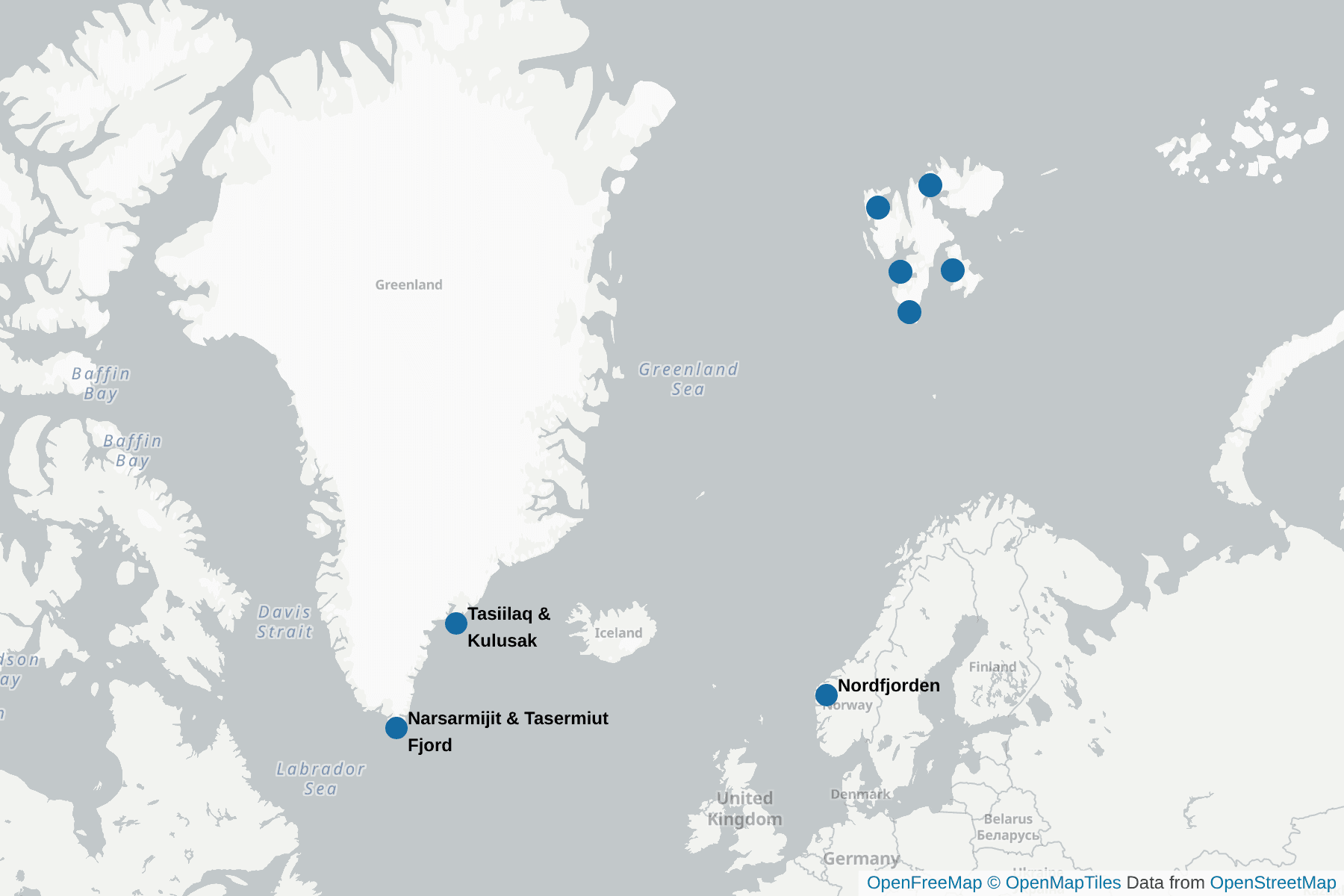
Highlights where the Barnacle Goose can be seen

QuarkExpeditions_Spitsbergen in Depth Arctic
Akseløya

A long narrow island of hard bedrock at the entrance to Van Mijentfjorden, the northern fjord arm of Bellsund. It is popular for a Zodiac cruise around the island and through the narrow Mariasundet, with the strong currents that attract seabirds.

There is the chance of landing to explore the geology, but with lots of scouting first to make sure there is not a hidden bear. The surrounding mountains provide some spectacular scenery and some impressive geology. But few cruise ships go further into this deep fjord, preferring to do landings in Bellsund, and to ship cruise into Hornsund.

G Expedition Arctic Longyearbyen
Arrival at Longyearbyen

The transport hub for Svalbard with the airport. Once just a mining town, it is now involved with tourism and scientific research and has various services, accommodation, shops and cafés, and some interesting museums.

There is also the chance to check out wildlife within town, including Snow Buntings and even reindeer, and to walk along the road through the mudflats to the dog kennels, dodging the Arctic Terns on route. There is an Eider colony next to the kennels and Barnacle Geese and other birds on the mudflats. If you are very lucky, you might see an Ivory Gull near the kennels.

Longyearbyen is the biggest settlement in Svalbard. Seat of the Norwegian administration, it also has the best services and infrastructure in the archipelago. Located deep in the Adventfjord, a sidearm of the Isfjorden (Icefjord), Longyearbyen’s airport can be used all-year round, but its harbor is blocked by ice in winter. Most shops, hotels, restaurants and a hospital are within easy walking distance of the port.

The 14th July Glacier
Fjortende Julibukta

The 14th of July bay and glacier, named by Prince Albert I of Monaco on the Princesse Alice on his oceanographic expeditions to Svalbard from 1898 to 1907.

It is one of the highlights in Krossfjorden, often combining a landing with a Zodiac cruise. Cruising along the impressive glacier front, there are regular calvings with bergs in the bay that attracts birds like kittiwakes. And nearby there are bird cliffs with a colony of Thick-billed Murres (Brünnich’s Guillemot) that also includes Atlantic Puffins. Options for landing (being careful of potential Tsunami waves from calvings) include one of the best spots in the whole of Svalbard for flowers, and even the chance to walk on the side of the glacier.

gnalodden
Gnålodden

Popular landing in Hornsund with spectacular scenery including towering bird cliffs with thousands of breeding Black-legged Kittiwakes and Brünnich’s Guillemots and all the noise (gnål means “nagging” in Norwegian), that attracts Arctic Foxes at the base of the cliff. Geese and reindeer also occur and it is a good location for plants.

Trappers called it Fuglefjell, the location being very popular as a base for hunting bears coming into Hornsund from the key breeding grounds around Hopen in SE Svalbard. The hunter’s cabin at the base of the cliff is famous as the place where the first female trapper stayed, Wanny Wolstead. Even today, staff need to carefully check for bears before going ashore, and sometimes a landing cannot occur if there is a bear on shore.

Black-legged Kittiwake (Atlantic) (Rissa t. tridactyla)
Haleysundet

This is the sound between Spitsbergen and Barentsøya and a second way to reach Hinlopenstretet instead of Freemansundet.

However, with the extremely strong currents few captains go this way, and usually later in the season, when there is less chance of ice floes hurtling through on the current, and at the right stage of the tide. It is a spectacular ship cruise, often with lots of feeding seabirds. There is a nearby passage that is far too narrow to sail through, but there is the option to go through this narrow passage by Zodiac whilst the ship goes through the main channel and picks up the Zodiacs on the other side. A really exciting and fun Zodiac cruise!

Hinlopenstretet
Hinlopenstretet

The sound between Spitsbergen and Nordaustlandet in the high Arctic, in contrast to the milder coast of western Spitsbergen. Early in the season it is locked in ice that slowly clears from the south.

The northern end can be blocked by the pack for a while, varying from season to season. Once open, it enables circumnavigation of Spitsbergen, although ice can still drift in on strong currents and block Hinlopenstretet. When Hinlopenstretet is open, but the northern end is still blocked, ships will come into the area, typically sailing along Freemansundet between Edgeøya and Barentsøya, then return.

The area is superb for Zodiac cruises and landings, and can be superb even as a ship cruise. There are plenty of seabirds, the sound can be good for whales, there are various fjords to explore, like the surprisingly arid and desert-like Wahlenbergfjorden, various island groups to explore, like Wahlbergøya, and the chance to experience what is described as the polar desert. Three locations stand out as highlights in whole of Svalbard, the ice cliff Bråsvellbreen, the Walrus Haul out at Torellneset , and the bird cliff at Alkefjellet.

Atlantic Walrus (Odobenus r. rosmarus) haul up
Kapp Lee

Located on the NW corner of Edgeøya at the entrance to Freemansundet, Kapp Lee is the location of a Walrus haul out that is also a good location for Reindeer, the chance of Arctic Fox, and great tundra vegetation.

It is also a site of cultural significance with the foundations of a Pomor dwelling and several hunters cabin including a hexagonal shaped hut that is right next to the Walrus haul out. Just above the shoreline on nearby beach are the remains of a Bow Head Whale where the carcass must have drifted ashore long ago. Now, with isostatic rebound (the land slowly rising up after being pushed down under the weight when the whole of Svalbard was under an ice sheet) the bones are a short distance above the shoreline.

Kongsbreen og Tre Kroner
Kongsvegen and Kongsbreen

The inner part of Kongsfjorden is popular for ship cruising and especially Zodiac cruising with the mountain scenery, some impressive glacier fronts, and the chance to explore the ice floes looking for wildlife, and the chance of a bear.

Also keep a look out for Long tailed Jaegers, one of the few places they breed in Svlbard is on the island of Ny London in the middle of Kongsford. A number of lakes and pools in the region can attract a range of waterbirds.

Krossfjorden Spitsbergen
Krossfjorden

The two split fjords that form the inner part of Krossfjorden are popular for ship cruising and Zodiac cruising to enjoy the scenery, the glacier fronts, and to look out for wildlife and the chance of a bear.

There are also several options for landings including Möllerhamna, with a hunter’s cabin painted orange that is known the ‘Lloyds Hotel’. Many cruise ships have visited the site for over 100 years, leaving behind mementoes like signs, graffiti (no longer allowed), and a bar. Sigenhamna is another location where there was a German weather station in World War II.

Spitsbergen
Lågøya

This island, and the associated smaller islands, is off the NW coast of Nordaustlandet. Lågøya means ‘low island’, and it is the site of a Walrus haul out and is great for bird life, with the chance of Sabine’s Gulls that are attracted to the lagoons on the island.

Part of the island is sea¬so¬nal¬ly pro¬tec-ted and off limits and landings are often thwarted by the presence of a bear, or bears. It is an area where there can be loose pack ice when the pack, further to the east, is still too compact to sail though. It means this location very popular for Zodiac cruising with the wildlife that can be encountered. There is at least one old hunter’s cabin on the island, but conditions were particularly harsh on Lågøya, some perishing on the island, making hunters reticent of over wintering here.

Disembark & goodbyes
Longyearbyen

Longyearbyen is the biggest settlement in Svalbard. Seat of the Norwegian administration, it also has the best services and infrastructure in the archipelago. Located deep in the Adventfjord, a sidearm of the Isfjorden (Icefjord), Longyearbyen’s airport can be used all-year round, but its harbor is blocked by ice in winter.

Most shops, hotels, restaurants and a hospital are within easy walking distance of the port. One of the most prominent buildings in town is the UNIS center, where several Norwegian universities have joined forces to operate and offer the northernmost higher education to both Norwegian and international students. Adjacent to UNIS, and well worth a visit, is the Svalbard Museum, covering the natural history and exploitation of Svalbard. Remnants of the former mining activity can be seen all around Longyearbyen and even in town.

A range of wildlife can be seen around the town and the mudflats on the road to the dog kennels. There is an Eider colony here and Ivory Gulls can sometimes be seen. If you can dodge the diving Arctic terns, the mudflats attract birds like Barnacle Geese, and a range of waterbirds and shorebirds that are scarce in other parts of Svalbard.

Arctic tern Magdalenefjorden
Magdalenefjorden

One of the most spectacular and most photographed fjords in Svalbard, and with all the pointed peaks it can be understood how Spitsbergen got its name. Very popular for the landing at Gravneset, with the whaler’s graveyard it is named after, with the remains of the blubber ovens from the whaling days.

The tundra is also great for plants and wildlife, from geese to Arctic Terns. Zodiac cruising is a great way to explore the rest of the fjord and to look out for wildlife that includes a huge Little Auk colony in the scree on the northern side (some quite close to the shore), and to look out for seals. As well as Ringed Seals and Bearded Seals there is a spot with Harbour Seals (the most northerly in the World?), and a site where Walrus haul on a sandy beach at the entrance of the fjord to the west of Gravneset. The Waggonwaybreen glacier has been retreating and ships can get quite close to witness carvings, a floating platform on the part of the open fjord that was covered by the glacier just a few years ago. Staff will always be on the lookout for bears that can turn up here.

Narsarmijit
Narsarmijit & Tasermiut Fjord

Pretty Greenland village at the southern tip of Greenland that was the easternmost of the Norse settlements during their colonization of Greenland, with remains in the area (most settlements were on the south-west coast).

The fjords are great to explore including Tasermiut Fjord with the largest hanging glacier in southern Greenland, with World challenging big walls for climbing such as Ulamertorsuaq and Nalumasortoq.

QuarkExpeditions_ Northwest Passage Arctic Canada
Nordfjorden

There are several deep fjords along the north coast of Isfjorden with glaciers coming down to the bay. These can be popular for Zodiac cruises along the glacial fronts, discover wildlife, and in some places, even to get ashore to walk on a glacier.

Puffin Raudfjorden
Raudfjorden

Further around the Northwest coast of Spitsbergen, further to the east, this fjord is often blocked off by the pack ice in the early season before, but is the first area to become free as the pack ice retreats from the NW corner of Spitsbergen.

The mountains in this area are rugged and the coast here may have been the land that Barents saw when he came up with the name of Spitsbergen. The name, ‘red fjord’ comes from the red sandstone in the south and east areas of the fjord. There is a hunter’s wooden cabin at Bruceneset and a cairn for a pioneer that died of scurvy whilst overwintering in 1907/08. The name is for the explorer William S. Bruce, the area named by Prince Albert I of Monaco on the Princesse Alice on his oceanographic expeditions to Svalbard from 1898 to 1907.

Russebukta Svalbard
Russebukta

On the SW coast of Edgeøya, the name means Russian’s Bay from when Pomor hunters were in the area.

This is an area of boggy tundra with numerous lakes that is a great location for a wide range of Svalbard birds and Reindeer in the Søraust-Svalbard Nature Reserve.

Smeerenburgfjorden - Svalbard
Smeerenburgfjorden

This extensive fjord system has impressive scenery and numerous glaciers that is great to explore by ship whilst being on the watch out for bears. It is also an area with lots of history.

Smeerenburg was the base for the Dutch whalers that was known as ‘blubber town’, with the remains of the blubber ovens for those that get ashore. There is also a Walrus haul out that can be observed from the shore, or from a Zodiac if there is a bear nearby (quite often the case here in the NW). Close by is Virgohamna, the site where Andrée set off his ill-fated trip to the North Pole by balloon in 1897, and where Wellman attempted to fly to the pole in the early 1900’s. Today there are the scattered remains of the balloon shed and the aircraft hangar. Special permission is required to land but the remains can be seen from a Zodiac offshore. Smeerenberg was also the location where the Fram appeared after drifting across the Arctic Ocean, stuck in the ice for three years!

Tasiilaq
Tasiilaq & Kulusak

Tasiilaq is the largest town in south-east Greenland, close to the mouth of the rugged and long Sermilik Fjord. With the ice sheet just to the west the Sermilik glacier carves numerous icebergs. Kulusak is nearby and with an airport is popular with the short flight from Iceland.

Area good for the landscape, whale watching, the wildlife, and the flora.

G Expedition Arctic Svalbard
Vårsolbukta

On the NW side of Bellsund, this is a huge Little Auk colony amongst the extensive scree on the side of the mountain ridges above the landing beach.

It can be a challenge to get to, and to scout, in case of bears, but it is a stunning wildlife spectacle with thousands of Little Auks wheeling around and calling (sounding like little trolls!). The activity also attracts Arctic Foxes and the tundra, with all the nutrients leaching down, is superb for plants, and to look out for geese and Reindeer.

Along the shore there is the chance of Beluga.

Arctic Beauty - Svalbard - Woodfjorden
Woodfjorden

This large fjord, and the associated Bockfjorden and Liefdefjorden in northern Spitsbergen, becomes accessible as the pack retreats. It is great for ship cruising, enjoying the scenery, and to look out for bears along the extensive coastline.

Flexibility is key with the chance of bears and changing weather conditions, but with plenty of choices in this large fjord complex. Zodiac cruises are popular, including Monacobreen glacier at the end of Liefdelfjorden, and the islands of Andøyane, a great area for a range of birds, including King Eider. There are also options for landings. The large and impressive wooden hut at Mushamna on the NE side of Woodfjorden. The small hunter’s cabin known as the Texas Bar in Liefdefjorden. The ‘thermal spring’ at Jotunkjeldane in Bockfjorden.

Our trips to spot the Barnacle Goose

Bruna Garcia

Your contact

Bruna

Call now

+1 347-493-2978

Weekdays from 5:00 to 16:00 EST

​
​
​
​
​
​
Bruna Garcia