Little Auk

Little Auk (Dovekie)

The tiny bird that gathers in enormous colonies


What you need to know about the Little Auk (Dovekie)

Our Expert Says… "These birds are amazing. It's thought that there may be as many as 40 million pairs worldwide. Little auk colonies are often in difficult to access areas on scree slopes, so not all expeditions can visit a colony. But if you get the chance, you must - it's remarkable due to the sheer numbers, the constant aerial movement, and the noise!"

The little auk (also known locally as the dovekie) is well-named! It’s the smallest of the Atlantic auk species, only about half the size of the Atlantic puffin. They are a very numerous bird, breeding in huge colonies on the side of rocky cliffs where they lay their single egg in cracks and crevices on the rocks.

Little auks have fly fast, with their small wings flapping rapidly in a blur of motion as they make their way from the nest to the sea’s surface from where they dive to hunt small crustaceans and sometimes juvenile fish. Like all auks, dovekie use their wings to “fly” underwater as they seek out their prey.

Little auks have a black head and neck, as well as black wings and back. Their underparts are white. They have a very short and stubby bill and a small, round black tail.

If you visit Greenland you could try a local Inuit food called kiviak. It is made by stuffing a seal skin with up to 500 little auks, feathers, beaks, and all, expelling as much air as possible, then sealing it shut with seal fat and leaving it under a heap of stones for three months. During this time, the little auks ferment, becoming a winter food source that is used to celebrate birthdays, weddings or other special occasions.

Pictures of Little Auk (Dovekie)

Little Auk

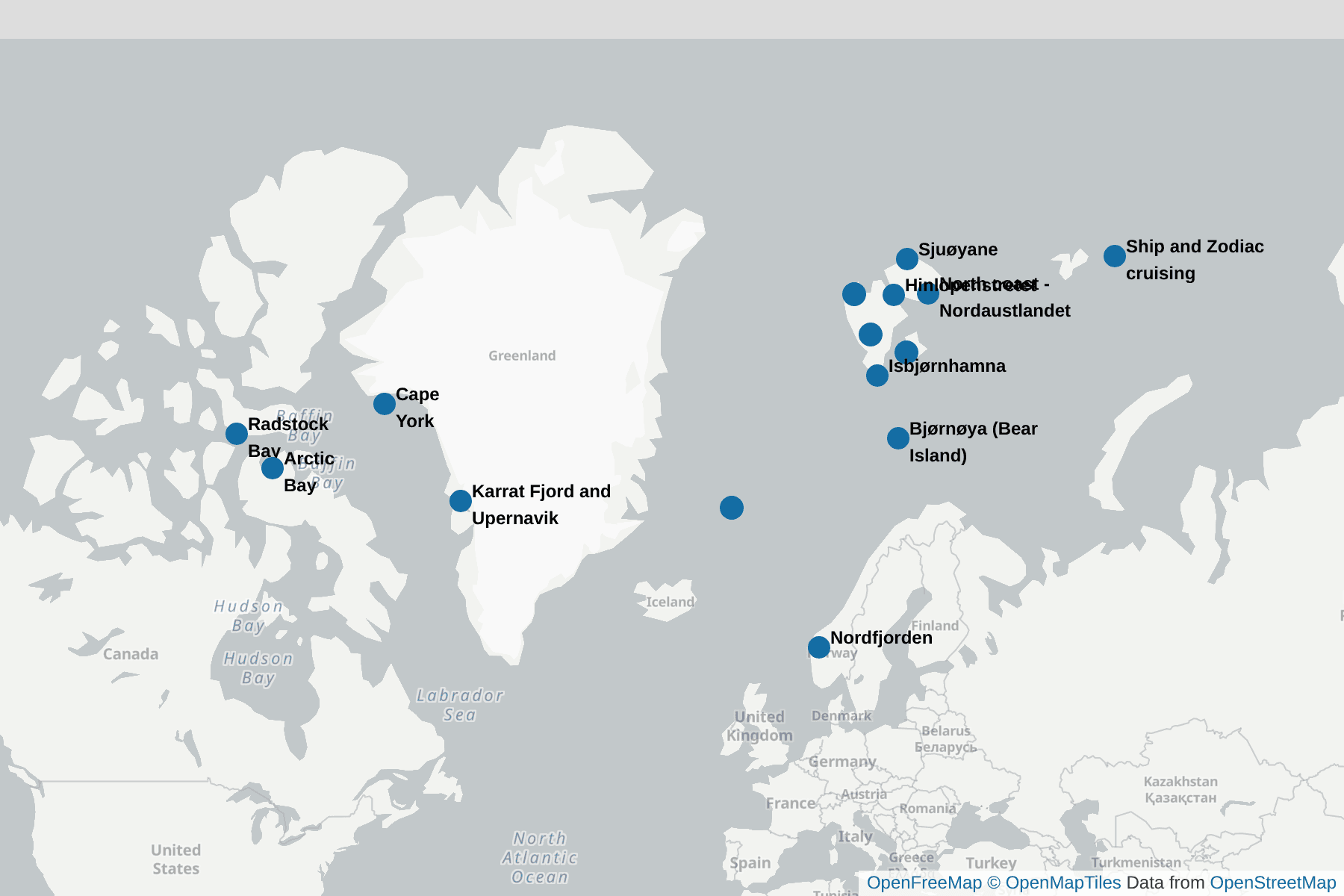
Highlights where the Little Auk (Dovekie) can be seen

Cross on Jan Mayen
17th-century Dutch whaling Station Remains

Jan Mayen’s 17th-century Dutch whaling station lies softened by thick moss, a stark reminder of early Arctic industry set against a raw volcanic coastline. On select landings, we walk across cinder and moss beds to explore the low ruins while Beerenberg’s snowy cone towers beyond and seabirds swirl overhead. It’s a haunting, atmospheric stop that pairs human history with wild, elemental scenery.

Arctic Beauty - Svalbard - Woodfjorden
Arctic Bay

On Admiralty Inlet on the very northwest side of Baffin Island.

Named after the whaling ship, the Arctic, in 1872, it is the site of quite a large community (mainly Inuktitut) called Ikpiarjuk, and a popular location to visit for expedition cruise ships. There is a museum and Ikpiarjuk a good place to learn about the culture. The area is great to ship cruise and explore for wildlife.

G Expedition Arctic Longyearbyen
Arrival at Longyearbyen

The transport hub for Svalbard with the airport. Once just a mining town, it is now involved with tourism and scientific research and has various services, accommodation, shops and cafés, and some interesting museums.

There is also the chance to check out wildlife within town, including Snow Buntings and even reindeer, and to walk along the road through the mudflats to the dog kennels, dodging the Arctic Terns on route. There is an Eider colony next to the kennels and Barnacle Geese and other birds on the mudflats. If you are very lucky, you might see an Ivory Gull near the kennels.

Longyearbyen is the biggest settlement in Svalbard. Seat of the Norwegian administration, it also has the best services and infrastructure in the archipelago. Located deep in the Adventfjord, a sidearm of the Isfjorden (Icefjord), Longyearbyen’s airport can be used all-year round, but its harbor is blocked by ice in winter. Most shops, hotels, restaurants and a hospital are within easy walking distance of the port.

Bjørnøya
Bjørnøya (Bear Island)

Bear Island is considered Svalbard’s southernmost island, roughly half way between Spitsbergen and Norway’s North Cape. Although the last polar bears were seen in 2004, the name goes back to Dutch explorer Willem Barentsz and his visit in 1596.

The island has been used to hunt walrus, for whaling, and even coal mining has taken place. The strategic location on the border of the Norwegian Sea and the Barents Sea has led to a meteorological station being set up by Norway near Gravodden on Bear Island’s north coast. Some two thirds of the island is a relatively flat plain with shallow freshwater lakes and Ramsar Wetland, while the entire island and the surrounding waters are a Nature Reserve.

Bear Island has also been designated an Import Bird Area as it is a staging area for Pink-footed and Barnacle Geese and the steep cliffs south of Sørhamna are home to thousands of breeding seabirds,the area of most interest for a ship cruise, and even a Zodiac cruise on the few occasions the seas is calm.

Icebergs at Cape York,Greenland
Cape York

In northwest Greenland in Melville Bay, the ice sheet comes right down to the coast, separating the very northwest part of Greenland from the rest of western Greenland.

Cape York is one of the first locations on this northwest coast that has tundra and lakes to explore. The mountains and icebergs match this remote location that, in many ways, has far more of a link with the Canadian Arctic, rather than Greenland.

It is one of the most important locations in NW Greenland for breeding seabirds and it can be good for marine mammals. Including traditional hunting ground, whalers and explorers have also visited the area, and the family of Admiral Robert Peary's family placed a monument in honour of his explorations on the cape.

Nice area to explore the tundra and enjoy the magnificent views.

Isfjorden
Cruising Isfjorden

The outer bay can be a very good area for whale watching and an area where Blue Whale can be seen for cruise ships departing or arriving at the mouth of the fjord.

Isfjorden is the largest fjord system in Svalbard with spectacular geology, such as the Devonian sediments along Dicksonfjord and Ekmanfjordat. Most cruise ships sail out the first evening, a chance to enjoy the scenery, to explore the rest of Svalbard, before coming back to consider landings and explore parts of Isfjorden on the last full day.

The 14th July Glacier
Fjortende Julibukta

The 14th of July bay and glacier, named by Prince Albert I of Monaco on the Princesse Alice on his oceanographic expeditions to Svalbard from 1898 to 1907.

It is one of the highlights in Krossfjorden, often combining a landing with a Zodiac cruise. Cruising along the impressive glacier front, there are regular calvings with bergs in the bay that attracts birds like kittiwakes. And nearby there are bird cliffs with a colony of Thick-billed Murres (Brünnich’s Guillemot) that also includes Atlantic Puffins. Options for landing (being careful of potential Tsunami waves from calvings) include one of the best spots in the whole of Svalbard for flowers, and even the chance to walk on the side of the glacier.

Little Auk / Dovekie (Alle a. alle)
Fuglesongen

The views of NW Spitsbergen, the land of the pointed peaks, is impressive from this area, once it is free of ice. Fuglesongen means ‘bird song’ and thousands of Little Auks breed here, flying around in huge ‘wheels’ of birds and sounding like little trolls!

A few determined groups make a landing here, but it needs calm conditions, sticking out on the NW tip of Spitsbergen. But is still an impressive site to witness for ships that sail between Fuglesongen and Klovningen. There is no land to the north, towards the pole, the area often covered in the pack ice at the start of the season.

Hinlopenstretet
Hinlopenstretet

The sound between Spitsbergen and Nordaustlandet in the high Arctic, in contrast to the milder coast of western Spitsbergen. Early in the season it is locked in ice that slowly clears from the south.

The northern end can be blocked by the pack for a while, varying from season to season. Once open, it enables circumnavigation of Spitsbergen, although ice can still drift in on strong currents and block Hinlopenstretet. When Hinlopenstretet is open, but the northern end is still blocked, ships will come into the area, typically sailing along Freemansundet between Edgeøya and Barentsøya, then return.

The area is superb for Zodiac cruises and landings, and can be superb even as a ship cruise. There are plenty of seabirds, the sound can be good for whales, there are various fjords to explore, like the surprisingly arid and desert-like Wahlenbergfjorden, various island groups to explore, like Wahlbergøya, and the chance to experience what is described as the polar desert. Three locations stand out as highlights in whole of Svalbard, the ice cliff Bråsvellbreen, the Walrus Haul out at Torellneset , and the bird cliff at Alkefjellet.

Polar Bear (Ursus maritimus)
Ice edge and pack ice

Option to explore the pack ice edge and rafts of pack ice within the archipelago for wildlife, highlights including Polar Bears, Bowhead Whales, and even Narwhal.

QuarkExpeditions_ Spitsbergen Photography: In Search of Polar Bears
Isbjørnhamna

Site of a Polish research base on NW side of Hornsund. A few cruises get the chance to visit the base and to go up to the Little Auk colony.

Uummannaq
Karrat Fjord and Upernavik

Karrat Fjord, towards the north end of the Uummannaq Bay system, is a great fjord to explore with icebergs, rugged mountains, blue fjords, with the chance to walk on the tundra and look for wildlife. Various species can be seen but others can be elusive due to the proximity of Upernavik.

Upernavik, on the island of the same name, is a very pretty town on the slopes of the island, surrounded by magnificent scenery, at the entrance to the local fjord systems. As well as the colourful houses there is the most northerly 'open air' museum in the World. It also boasts to have the World's largest bird cliffs nearby.

There are a a few settlements further north before the ice sheet comes right down to the coast in Melville Bay between western Greenland and the very NW tip and Thule.

Kongsbreen og Tre Kroner
Kongsvegen and Kongsbreen

The inner part of Kongsfjorden is popular for ship cruising and especially Zodiac cruising with the mountain scenery, some impressive glacier fronts, and the chance to explore the ice floes looking for wildlife, and the chance of a bear.

Also keep a look out for Long tailed Jaegers, one of the few places they breed in Svlbard is on the island of Ny London in the middle of Kongsford. A number of lakes and pools in the region can attract a range of waterbirds.

Krossfjorden Spitsbergen
Krossfjorden

The two split fjords that form the inner part of Krossfjorden are popular for ship cruising and Zodiac cruising to enjoy the scenery, the glacier fronts, and to look out for wildlife and the chance of a bear.

There are also several options for landings including Möllerhamna, with a hunter’s cabin painted orange that is known the ‘Lloyds Hotel’. Many cruise ships have visited the site for over 100 years, leaving behind mementoes like signs, graffiti (no longer allowed), and a bar. Sigenhamna is another location where there was a German weather station in World War II.

 Kvalrossbukta Landing Site, Jan Mayen
Kvalrossbukta Landing Site, Jan Mayen

A relatively sheltered bay on the west coast, Kvalrossbukta is one of the standard landing sites. When conditions and permits line up, we aim to visit the Olonkinbyen weather station on the east side and link the two with a memorable 3-hour hike across lava fields and cinder cones, with Beerenberg towering above.

Disembark & goodbyes
Longyearbyen

Longyearbyen is the biggest settlement in Svalbard. Seat of the Norwegian administration, it also has the best services and infrastructure in the archipelago. Located deep in the Adventfjord, a sidearm of the Isfjorden (Icefjord), Longyearbyen’s airport can be used all-year round, but its harbor is blocked by ice in winter.

Most shops, hotels, restaurants and a hospital are within easy walking distance of the port. One of the most prominent buildings in town is the UNIS center, where several Norwegian universities have joined forces to operate and offer the northernmost higher education to both Norwegian and international students. Adjacent to UNIS, and well worth a visit, is the Svalbard Museum, covering the natural history and exploitation of Svalbard. Remnants of the former mining activity can be seen all around Longyearbyen and even in town.

A range of wildlife can be seen around the town and the mudflats on the road to the dog kennels. There is an Eider colony here and Ivory Gulls can sometimes be seen. If you can dodge the diving Arctic terns, the mudflats attract birds like Barnacle Geese, and a range of waterbirds and shorebirds that are scarce in other parts of Svalbard.

Arctic tern Magdalenefjorden
Magdalenefjorden

One of the most spectacular and most photographed fjords in Svalbard, and with all the pointed peaks it can be understood how Spitsbergen got its name. Very popular for the landing at Gravneset, with the whaler’s graveyard it is named after, with the remains of the blubber ovens from the whaling days.

The tundra is also great for plants and wildlife, from geese to Arctic Terns. Zodiac cruising is a great way to explore the rest of the fjord and to look out for wildlife that includes a huge Little Auk colony in the scree on the northern side (some quite close to the shore), and to look out for seals. As well as Ringed Seals and Bearded Seals there is a spot with Harbour Seals (the most northerly in the World?), and a site where Walrus haul on a sandy beach at the entrance of the fjord to the west of Gravneset. The Waggonwaybreen glacier has been retreating and ships can get quite close to witness carvings, a floating platform on the part of the open fjord that was covered by the glacier just a few years ago. Staff will always be on the lookout for bears that can turn up here.

QuarkExpeditions_ Northwest Passage Arctic Canada
Nordfjorden

There are several deep fjords along the north coast of Isfjorden with glaciers coming down to the bay. These can be popular for Zodiac cruises along the glacial fronts, discover wildlife, and in some places, even to get ashore to walk on a glacier.

Atlantic Walrus (Odobenus r. rosmarus) male
North coast - Nordaustlandet

With most of the island under the icecaps of Austfonna and Vestfonna, this rugged coastline is not covered by the ice cap, including Kapp Platten, but few ships visit this remote coast, preferring to explore Sjuøyane.

Pyramiden
Pyramiden

This Russian mining town that used to be the largest settlement in Svalbard. Abandoned in 1998, it must have been impressive in the 1970s and 1980s, with wide avenues and lawns, Soviet architecture, and lots of families.

Today it is a very eerie and atmospheric, with the mining facilities falling apart over quite a large area, on the flats and the hills above the town. There are the various Soviet era structures and artwork, including the school playground, the cultural center, the food hall, and the most northerly swimming pool in the World (dry now) and bust of Lenin.

There is a hotel, still open, with a bar that you can visit. But you need to go with someone with a rifle, since bears do roam through town! It is also a good place to see Arctic Fox, and one of the most reliable places to see the Ptarmigan, the ‘Arctic’ grouse. The name comes from the shape of the mountain behind the town, which adds to the character of the place.

Croker Bay, Nunavut, Canada
Radstock Bay

Situated close to the southwest corner of Devon Island with Viscount Melville Sound nearby.

Great ship cruising in a location close to where Lancaster Sound splits into a myriad of channels that made the exploration of the northwest passage so challenging.

Aurora Expeditions Sylvia Earle South Georgia & Antarctic Odyssey
Ship and Zodiac cruising

With the myriad of islands and channels, and the ice, there needs to be a lot of flexibility of where to explore within the Franz Joseph archipelago. But there is the chance to see a range of Arctic wildlife, such as the Polar Bear and Walrus, plus species like Bowhead Whale and Narhwal that are scarcer in Svalbard waters.

Many of the ships that head up to the north pole pass through the islands.

Purple Sandpiper (Calidris maritima) summer plumage adult
Sjuøyane

A series of hard granite islands that translates as seven islands, islands that are to the north of Nordaustlandet. Being the furthest north in the whole of Svalbard, the islands can remain in the pack ice for much of the year.

Walrus can be seen throughout the area, with at least one popular landing at a haul out. There are plenty of seabirds, and the chance of a bear resting somewhere on one of the islands, sometimes several bears, understandable with the location. With the myriad of islands it is very popular to explore by Zodiac and the area also has important ties to polar exploration. Many of the locations were named after the English North Pole expeditions led by Phipps (1773) and Parry (1827), including Neslonøya, after a certain young midshipman! Not that long ago the whole area could be trapped in ice throughout the year and just to the east was the area where Nobile’ airship, the Italia, crashed onto the ice, with a huge rescue effort.

Skansbukta
Skansbukta

Remains of a gypsum mine below spectacular and beautiful cliffs. In addition to the cultural remains, including parts of a railway and a barge, it has an interesting flora due to the ‘mild’ location, deep inside Isfjorden.

Nearby cliffs, which go right down to the sea, are eroded into impressive shapes, and can be a great place to explore offshore in a Zodiac, the chance to see various seabirds that breed on the cliffs, with kittiwakes and four auk species including Puffins. It is a popular site for a combined landing and Zodiac cruise, and a ‘sail’ past on boats out from Longyearbyen that are visiting Pyramiden.

Smeerenburgfjorden - Svalbard
Smeerenburgfjorden

This extensive fjord system has impressive scenery and numerous glaciers that is great to explore by ship whilst being on the watch out for bears. It is also an area with lots of history.

Smeerenburg was the base for the Dutch whalers that was known as ‘blubber town’, with the remains of the blubber ovens for those that get ashore. There is also a Walrus haul out that can be observed from the shore, or from a Zodiac if there is a bear nearby (quite often the case here in the NW). Close by is Virgohamna, the site where Andrée set off his ill-fated trip to the North Pole by balloon in 1897, and where Wellman attempted to fly to the pole in the early 1900’s. Today there are the scattered remains of the balloon shed and the aircraft hangar. Special permission is required to land but the remains can be seen from a Zodiac offshore. Smeerenberg was also the location where the Fram appeared after drifting across the Arctic Ocean, stuck in the ice for three years!

Storfjorden, Norway
Storfjorden

The large bay/sea between SE Spitsbergen and the islands of Edgeøya and Barentsøya that can be a good location for whale watching.

The bays along the coast of SE Spitsbergen can often be good ‘fast ice’ to the land that can attract a lot of bears as areas of fast ice start to reduce.

G Expedition Arctic Svalbard
Vårsolbukta

On the NW side of Bellsund, this is a huge Little Auk colony amongst the extensive scree on the side of the mountain ridges above the landing beach.

It can be a challenge to get to, and to scout, in case of bears, but it is a stunning wildlife spectacle with thousands of Little Auks wheeling around and calling (sounding like little trolls!). The activity also attracts Arctic Foxes and the tundra, with all the nutrients leaching down, is superb for plants, and to look out for geese and Reindeer.

Along the shore there is the chance of Beluga.

Whales & Dolphins
Whale Watching

The shallow seas off South West Svalbard and the drop-off into deeper waters are probably the best places for whale watching in Svalbard.

In addition to the Humpback Whale, Fin Whale, and Blue Whale, the SW is a good area to see White-beaked Dolphins (more elusive to the NW), whilst heading further out to deeper waters, there is the chance of spotting Sperm Whales and the Northern Bottlenose Whale.

Arctic Beauty - Svalbard - Woodfjorden
Woodfjorden

This large fjord, and the associated Bockfjorden and Liefdefjorden in northern Spitsbergen, becomes accessible as the pack retreats. It is great for ship cruising, enjoying the scenery, and to look out for bears along the extensive coastline.

Flexibility is key with the chance of bears and changing weather conditions, but with plenty of choices in this large fjord complex. Zodiac cruises are popular, including Monacobreen glacier at the end of Liefdelfjorden, and the islands of Andøyane, a great area for a range of birds, including King Eider. There are also options for landings. The large and impressive wooden hut at Mushamna on the NE side of Woodfjorden. The small hunter’s cabin known as the Texas Bar in Liefdefjorden. The ‘thermal spring’ at Jotunkjeldane in Bockfjorden.

Our trips to spot the Little Auk (Dovekie)