Polar Tours Logo 1200px full color svg

All Dates & Prices

Trip Type

Antarctica

Arctic

Info

Home

All Dates & Prices

Trip Type

Ship Size

All Ships & How to choose the best

Large Ships

Micro-Cruises

Mid-Sized Ships

Small Ships

Ways to travel

Classic Cruises

Discounted Cruises

Luxury Cruises

Polar Expeditions for Solo Travelers

Premium Cruises

Antarctica

Antarctica

All Dates+Prices

Antarctic Season 2025/2026

Antarctic Season 2026/2027

Info

Air Cruises: Fly to Antarctica!

All Black Friday Offers (24-30 Nov)

Antarctica Last Minute Offers

Antarctica Travel Information

Download Our Free Antarctica Guidebook

Weather in Antarctica

Wildlife of Antarctica

Top Destinations

Antarctic Sound & Weddell Sea

Cruises beyond the Antarctic Circle

South Georgia

South Shetland Islands

Travel Styles

Antarctica Luxury Cruises

Cheapest Antarctica Cruises

More Comfort: Antarctica Large Ship Cruises

Small Ship Expedition Cruises to Antarctica

Arctic

Artic

All Dates+Prices

Info

All Black Friday Offers (24-30 Nov)

Arctic Travel Information

Arctic Trips for Solo Travelers

Download Our Free Arctic Guidebook

Wildlife of the Arctic

Top Destinations

Canadian Arctic

Greenland

Iceland

North Pole

Northern Lights Cruises

Northwest Passage

Svalbard

Travel Styles

Arctic First Class Cruises

Arctic Luxury Cruises

Arctic Small Ship Expedition Cruises

Artic Last Minute Cruises

Discounted Arctic Cruises

Polar Bear Tours

Small Ship Cruises in Svalbard

Info

Info

Activities & Add-Ons

Blog

FAQ

Free Polar Guidebook

Our Team

Sustainable Tourism

Travel Insurance for EU + CH Residents

Trips for Solo Travelers

What our travelers say

YouTube: Polar Expert Talks

Your Advantages

All deals in one place

Best Price Guarantee

Free Video Consultation

No Hidden Fees

Unbiased Recommendations

Why book with us?

Your money is protected

Contact us

Weekdays from 5:00 to 16:00 EST

$
​
​
$
​
​

Sign up for our Polartours newsletter

Get travel inspiration from Antarctica and the Arctic and receive exclusive discounts.

​
Polar Tours Logo 1200px full color svg

Luxury Cruises

Island Sky

SH Diana

Scenic Eclipse I

Silver Cloud

Silver Explorer

Silver Wind

Ultramarine

Premium Cruises

Douglas Mawson

Freya

Greg Mortimer

Hebridean Sky

Kinfish

Magellan Discoverer

Magellan Explorer

Classic Cruises

50 Years of Victory

G-Expedition

Hans Hansson

Hondius

Janssonius

Kapitan Khlebnikov

MS Balto

Further Links

Best Price Guarantee

Ernest Shackleton

Join our team!

Last Minute Deals

Mandatory Insurance

Packing List

Trips departing from Punta Arenas

Further Information

FAQ

Terms & Conditions

Careers

ventura TRAVEL

Contact Us

🇺🇸 +1 347-493-2978

🇬🇧 +44 20 4571 8661

🇩🇪 +49 30 3119 3691

🇫🇷 +33 1 76 38 06 39

service(at)polartours.com

Contact Form

Weekdays from 5:00 to 16:00 EST

gyrfalcon

Gyrfalcon

Magnificent polar bird of prey that hunts over the arctic plains

What you need to know about the Gyrfalcon

Our Expert Says… "Although there is a worry about the impact of climate change, I'm hopeful that because there is so much habitat available in the high Arctic, the gyrfalcons and peregrines have the space to co-exist and weather the storm. I've had good sightings on trips to Greenland in particular."

The gyrfalcon is the world’s largest falcon and it’s a breeding resident of the Arctic coasts and tundra.

This magnificent and iconic polar bird of prey is very large. Males can grow up to 60cm (2ft) long and have a 1.3m (50”) wingspan and weigh up to 1.4kg (3lb), with females being even larger and heavier with a wingspan of up to 1.6m (63”). Similar in size to a buzzard, it is sometimes confused with them, but one differentiator is that the gyrfalcon has pointed wings

Gyrfalcons are highly polymorphic, meaning that their coloration can be one of several types. Individuals have been noted in all colors from white ranging to very dark plumage.

The gyrfalcon hunts small birds and mammals. Unlike other falcons such as the peregrine, the gyrfalcon does not hunt from a high “stoop” but pursues prey horizontally. They kill on the ground, and if they catch a bird they will bring it down before they dispatch it.

Gyrfalcons always nest on cliff faces, and never build their own nest - either laying on bare rock or using an abandoned nest of a species like golden eagles or ravens. They lay between 3 and 4 eggs, although some pairs have been known to lay a single egg or as many as 5.

Adult gyrfalcons have no known predators other than the golden eagle, and even these attacks are rare given the gyrfalcon’s size. Chicks and eggs can be predated by common ravens, although the gyrfalcon is known for aggressively defending its nest and chicks.

The gyrfalcon is not considered threatened due to its large range and distribution. However, there are worrying signs that climate change is pushing the hunting territory of peregrine falcons further north. Although the gyrfalcon is larger than the peregrine, they are conflict-averse away from their nests and so unable to successfully compete.

Pictures of Gyrfalcon

Gyrfalcon

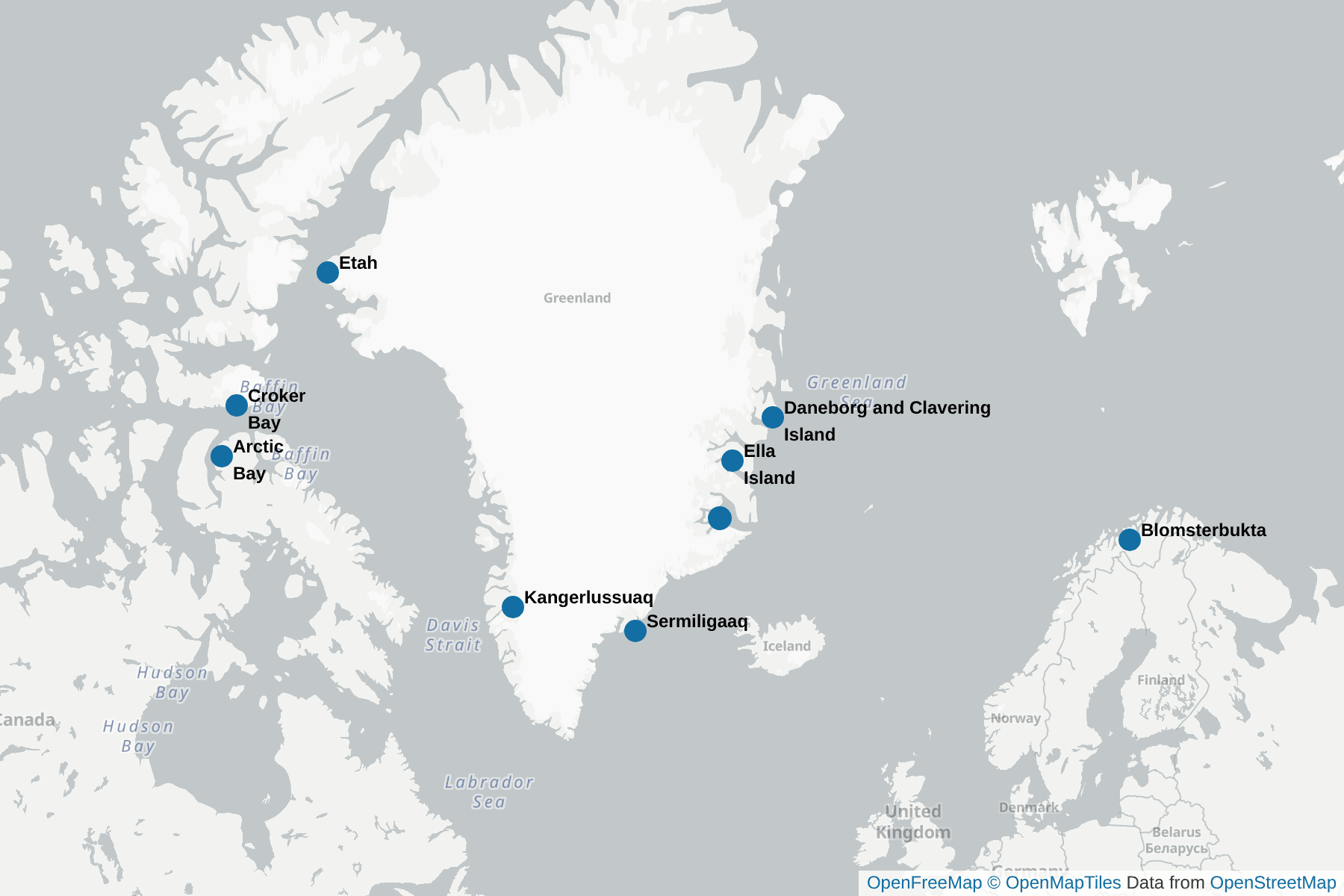
Highlights where the Gyrfalcon can be seen

Arctic Beauty - Svalbard - Woodfjorden
Arctic Bay

On Admiralty Inlet on the very northwest side of Baffin Island.

Named after the whaling ship, the Arctic, in 1872, it is the site of quite a large community (mainly Inuktitut) called Ikpiarjuk, and a popular location to visit for expedition cruise ships. There is a museum and Ikpiarjuk a good place to learn about the culture. The area is great to ship cruise and explore for wildlife.

Greenland
Blomsterbukta

‘Flower Bay’, a great walk along a gulley to a lake at Blomsterbogten and to explore the tundra for flowers and wildlife, plus a hunter’s cabin. Part of the King Oscar Fjord system it is often combined with a visit to Ella Island in the same day.

croker bay
Croker Bay

One of the deeper inlets into Devon Island, on the southeast side, but further west from Dundas Harbour. Great ship cruising with icebergs and the flat-topped mountain geology of this part of Devon Island.

Greenland
Daneborg and Clavering Island

Daneborg, on the south coast of Wollaston Foreland peninsula, is the location of the Danish Sirius Patrol that patrols NE Greenland and the vast national park.

Cruise ships check in here coming in from Svalbard then explore nearby fjords, making sure sea ice coming south in the East Greenland current does block off the entrances to the fjord systems. Some of this sea ice can include multi year ice that has drifted south from the Arctic Ocean, in complete contrast to the warming influence of the Gulf stream on the west coast of Svalbard, not that far to the east.

Across Young Fjord is Clavering Island, were Clavering and his crew of the Griper encountered a band of twelve Inuit in August 1823. Later explorers to the region found no evidence of inhabitants in NE Greenland. There are the remains of Inuit settlements and it appears, when the the first European explorers turned up, the small population was already dying out or moving on. Possibly the combination of cold conditions at the time, and trying to survive in one of the harshest areas on the plane, even for the Innuit - NE Greenland. There was also a weather station on the island.

Greenland
Ella Island

Located at the mouth of Kempe Fjord in the northern end of King Oscar Fjord. With the larger islands to the east such as Geographical Society Island.

It is in the middle of the King Oscar Fjord and Kaiser Franz Joseph Fjord ‘complex’ that matches Scoresbysund to the south. It is a great area to explore with stunning scenery, often the first Greenland landscape that many cruise ships experience that have come across from Svalbard, and you may even find wolf tracks on walks ashore. But expeditions tend to spend more time in Scoresbysund since the entrance to this fjord system can be blocked off by sea-ice drifting south in the cold southern flowing East Greenland current.

pause for reflection
Etah

At the very northern end of Baffin Bay and the very northwest of Greenland, Etah looks across the Nares Strait to Ellesmere Island, the area usually frozen from October to July.

The area was the crossing point to Greenland for cultures 4,400 and 2,700 years ago, the Thule culture migrants less than a thousand years ago, and the point of the last migration of the Inuit from Baffin Island reached the coast of Greenland in 1865 Etah was also a starting point for various expeditions attempting to get to the North Pole.

Today the channel, when frozen, continues to be a crossing point for wildlife from Canada to Greenland, even Wolverine get across. Etah used to be the most-northerly populated settlement in the world, but it was abandoned (Inuit moving south to Pituffik) due to the harsh conditions.

Hekla Havn
Føhnfjord

Sheer sided fjord on the south side of Milneland. Great ship cruising, often as part of the circumnavigation of Milneland.

Denmarkøya, on the south-east side of Milne Island, is the location of a group of small islands with landing potential at the end of Føhnfjord, at a position between the deeper fjord systems and the open ‘bay’ of Scoresbysund. The popular landing here is Hekla Havn, named after the expedition ship used by Carl Ryder when the expedition explored NE Greenland from 1891 to 92. As well as the hut remains from the expedition, there are older Innuit remains, as well as good tundra walks, wildlife, and some great geology.

Kangerlussuaq Airport
Kangerlussuaq

North of the Arctic Circle and deep in the long Kangerlussuaq fjord, it was the site of a WWII airport, then for refuelling for trans-continental flights.

The airport and the fjord are used as pick-up and drop off for cruise ships exploring the remoter parts of west Greenland. There are few roads in Greenland, but a 25 km dirt road connects the town with the mighty ice cap. Nowhere else is there easier access to the Greenland ice cap. Area also good for caribou, Musk Ox (actually introduced to this part of Greenland), and to look out for White-tailed Eagles.

Milneland
Milneland

A large and rugged island with steep cliffs, well into SW Scoresbysund that can be circumnavigated with access to several deeper fjord systems with glaciers coming down from the Greenland ice sheet.

Starting from the open sound (the actual area named Scoresbysund) and going in a clockwise direction from the Bear Islands: Ofjord to Storo island, then Rodefjord, then Føhnfjord back to the islands of Denmarkøya. Great ship and Zodiac cruising (even over several days), plus the chance of some landings. Spectacular ship cruising, Greenland at its best and a 'destination' within a destination with numerous highlights.

Much of the area has steep sided fjords, but where there are slopes with tundra, look at for Musk-ox.

Greenland fjord
Ofjord & Bear Islands

Ofjord means ‘island fjord’ with great ship cruising along this spectacular fjord deep into SW Scoresbysund.

The steep sided fjord is between two large islands, Renland and Milneland. The Bear Islands are at the start of Ofjord, a good landing that looks over the more open part of Scorsebysund. At the end of Ofjord is Storo island, the junction of several fjords coming down from the ice sheet, as well the route around Milneland.

Sermiligaaq
Sermiligaaq

On south-east coast just below the Arctic circle, a small and pretty fishing village on a peninsula in Sermilik Fjord.

In Kalaallisut it means "Beautiful glacier fjord” and includes the vast Knud Rasmussen Glacier and the Kârale Glacier. Due west from Iceland, it can be a popular first landing and cruise and to explore for Greenland wildlife, some of which can be more elusive further south, and, if you are very lucky, a Polar Bear, that are scarcer to the south.

Our trips to spot the Gyrfalcon

Bruna Garcia

Your contact

Bruna

Call now

+1 347-493-2978

Weekdays from 5:00 to 16:00 EST

​
​
​
​
​
​
Bruna Garcia