Polar Tours Logo 1200px full color svg

All Dates & Prices

Trip Type

Antarctica

Arctic

Info

Home

All Dates & Prices

Trip Type

Ship Size

All Ships & How to choose the best

Large Ships

Micro-Cruises

Mid-Sized Ships

Small Ships

Ways to travel

Classic Cruises

Discounted Cruises

Luxury Cruises

Polar Expeditions for Solo Travelers

Premium Cruises

Antarctica

Antarctica

All Dates+Prices

Antarctic Season 2025/2026

Antarctic Season 2026/2027

Info

Air Cruises: Fly to Antarctica!

Antarctica Last Minute Offers

Antarctica Travel Information

Download Our Free Antarctica Guidebook

Weather in Antarctica

Wildlife of Antarctica

Top Destinations

Antarctic Sound & Weddell Sea

Cruises beyond the Antarctic Circle

South Georgia

South Shetland Islands

Travel Styles

Antarctica Luxury Cruises

Cheapest Antarctica Cruises

More Comfort: Antarctica Large Ship Cruises

Small Ship Expedition Cruises to Antarctica

Arctic

Artic

All Dates+Prices

Info

Arctic Travel Information

Arctic Trips for Solo Travelers

Download Our Free Arctic Guidebook

Wildlife of the Arctic

Top Destinations

Canadian Arctic

Greenland

Iceland

North Pole

Northern Lights Cruises

Northwest Passage

Svalbard

Travel Styles

Arctic First Class Cruises

Arctic Luxury Cruises

Arctic Small Ship Expedition Cruises

Artic Last Minute Cruises

Discounted Arctic Cruises

Polar Bear Tours

Small Ship Cruises in Svalbard

Info

Info

Activities & Add-Ons

Blog

FAQ

Free Polar Guidebook

Our Team

Sustainable Tourism

Travel Insurance for EU + CH Residents

Trips for Solo Travelers

What our travelers say

YouTube: Polar Expert Talks

Your Advantages

All deals in one place

Best Price Guarantee

Free Video Consultation

No Hidden Fees

Unbiased Recommendations

Why book with us?

Your money is protected

Contact us

Weekdays from 5:00 to 16:00 EST

$
​
​
$
​
​

Sign up for our Polartours newsletter

Get travel inspiration from Antarctica and the Arctic and receive exclusive discounts.

​
Polar Tours Logo 1200px full color svg

Luxury Cruises

Island Sky

SH Diana

Scenic Eclipse I

Silver Cloud

Silver Explorer

Silver Wind

Ultramarine

Premium Cruises

Douglas Mawson

Freya

Greg Mortimer

Hebridean Sky

Kinfish

Magellan Discoverer

Magellan Explorer

Classic Cruises

50 Years of Victory

G-Expedition

Hans Hansson

Hondius

Janssonius

Kapitan Khlebnikov

MS Balto

Further Links

Best Price Guarantee

Ernest Shackleton

Join our team!

Last Minute Deals

Mandatory Insurance

Packing List

Trips departing from Punta Arenas

Further Information

FAQ

Terms & Conditions

Careers

ventura TRAVEL

Contact Us

🇺🇸 +1 347-493-2978

🇬🇧 +44 20 4571 8661

🇩🇪 +49 30 3119 3691

🇫🇷 +33 1 76 38 06 39

service(at)polartours.com

Contact Form

Weekdays from 5:00 to 16:00 EST

Neko Harbour

Neko Harbour

Gentoo penguins and Weddell Seals live among the remains of a historic refuge

Information about Neko Harbour

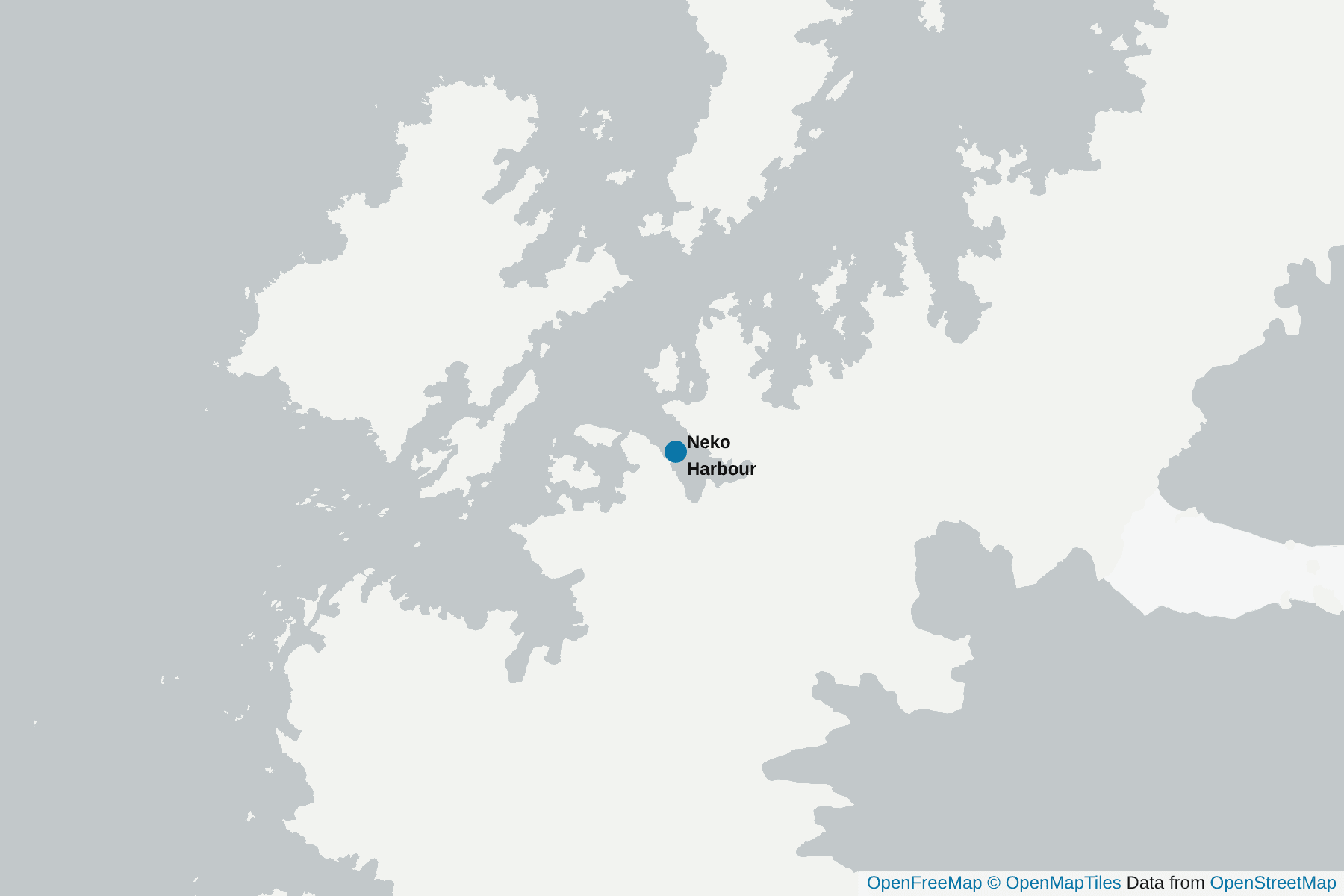
Neko Harbour is an inlet deep in Andvord Bay off the coast of Graham Land in the Antarctic Peninsula. It was discovered by a Belgian expedition in the early 1900s. This sheltered inlet was named after The Neko, a Scottish whaling vessel that worked these waters between 1910 and 1925.

Neko Harbor has a beach and a rocky outcrop that is surrounded by glaciers and towering cliffs. This is a popular site with spectacular views as the glaciers that surround this bay regularly carve during the season, leading to some stunning photo and video opportunities if you are lucky!

There used to be a refuge hut here that was built by Argentina in 1949, and was in irregular use all the way until 2009 when it was destroyed in a severe storm. It has since been cleared from the site, with just a few remains now to be seen.

The gentoo penguins that live here and used to surround the refuge hut don’t seem to mind that it has gone! Their noisy cries will greet you as you land on the beach. You can often also see Weddell seals here in the sea or hauled out on the beach at Neko Harbour. There are also skuas and kelp gulls seen regularly here.

Interesting facts about Neko Harbour

The foundations of an Argentine refuge hut are still visible. Following weather damage in 2010 the hut was removed and the site cleared.

This is a landing on the main peninsula and it is important to stay away from the beach with the number of carvings from the glacier that towers behind the landing that can lead to Tsunami waves. So listen to staff. The best advice? get to a viewpoint above the beach and enjoy the view.

There is also am mazing view form a higher viewpoint over the bay, but with crevices nearby, staff normally lead or flag a route to the viewpoint.

Th area is also superb for a Zodiac cruise, and do stay on deck for the sail into and out of Andvord Bay with the snow covered mountain, numerous glaciers tumbling down to the sea, and the sea ice and icebergs. On a calm and clear day the reflections can be stunning.

Pictures of Neko Harbour

Highlights Close to Neko Harbour

Aurora Expeditions Greg Mortimer Spirit of Antarctica
Astrolabe Island

Astrolabe Island in 3 miles long, and can be found about 14 miles off the Cape Ducorps in the Bransfield Strait on the Trinity Peninsula. It was discovered in 1837 and named after the French expedition ship that found it.

There is a wonderful crescent beach on the northern shore which is where you will land. Depending on the time of year you might have to pick your landing spot carefully to avoid the Antarctic fur seals who breed here and can be aggressive if they have very young pups.

The main attraction is the chinstrap penguin colony, several thousand strong. On your way in or out of this site, you will no doubt sail close to a group of impressive rocks that stick out of the sea to the northeast, known as the Dragon’s Teeth. Some of our expert Antarctic cruise guides have decided that if your ship sails in between any of the teeth, that means you have “flossed” Astrolabe Island!

Image without description
Cuverville Island

This small, steep-sided island is only 1.5 by 1.25 miles and two-thirds of it sits under a permanent ice-cap. On its northern shore is a pebble and boulder beach backed by steep cliffs where you will arrive by zodiac from your Antarctic cruise vessel and come ashore.

At both ends of this beach are the impressive Gentoo penguin colonies that Cuverville is famed for. You will be able to clearly see the trails they use to make their way to and from the water. There are other colonies and nesting sites on the higher ground behind the beach, and throughout the island.

You can also see the evidence of the whaling activity that went on here in the early 1900s, including discarded whale bones and the remains of the equipment used to hall them ashore for processing. If you are lucky, you might see Humpback Whales and Antarctic Minke Whales offshore.

This small island is carefully protected - only one ship at a time may land passengers here and there are other restrictions to ensure the wildlife is not unnecessarily disturbed. Some areas of the island are closed to visitors, but the rest allows you to roam freely, and your expert guides will show you the resident flora and fauna, as well as explaining the island’s whaling history.

damoy point
Damoy Point

Damoy Point is a rocky headland on the west coast of Wiencke Island, near the northern entrance to the natural harbor at Port Lockroy. It was discovered and mapped by the French Antarctic expedition of 1903 led by Charcot.

The point is rather unassuming and at first glance doesn’t warrant a visit. However, it has a couple of hidden gems - two very well-preserved expedition huts.

The first, known as Damoy Hut, was built in 1973 and was used by the British Antarctic Survey as a summer air facility and a personnel transfer station, but hasn’t been used since 1993.

The interior is in excellent condition and almost looks as if it could be put back into use straight away. There are even tin cups hanging on the kitchen wall as if ready to give travel-weary scientists a restoring cup of tea!

Just outside Damoy Hut is a refuge built by Argentina in the 1950s. This is not open to visitors and is still in use as an emergency refuge should the need ever arise.

Apart from these historic buildings, visitors will see a small colony of Gentoo penguins who breed here, as well as plenty of seals and sea birds.

Image without description
Danco Island, Errera Channel

Danco is a small island in the middle of the Errera Channel, a body of water that runs between Rongé Island and the coast of Graham Land.

Only 1 mile long, Danco’s wide, flat beach rises to a permanently ice-covered hill which gives stunning views over the channel. Visitors often report being able to see Humpback and Minke whales from here as they travel between the islands The view from the top with icebergs in the channel and crevassed glaciers in the surrounding mountains is stunning.

The island hosts around 1500 breeding pairs of gentoo penguins. They like to nest away from the beach up the slopes, and so you can always see them making their journeys to and from the sea, and Danco Island can have some of the best penguin highways in the snow where the Gentoo Penguins climb up and down to the colonies on the higher part of the island.

Seals are also frequent visitors to the island, as are a variety of Antarctic bird species including skuas, terns, and kelp gulls.

Danco was also the site of Base “O”, built by the British Antarctic Survey in 1954 as a base for geological research and exploration. The base was abandoned in 1959 when the expedition ended, and the huts were removed in 2004. On the beach, you can find a plaque with an inscription giving the story of the base.

Trinity island
D’Hainaut & Trinity Island

D’Hainaut Island is a tiny rock island in Mikkelsen Harbour. It’s less than half a square mile in size, and it’s approached through a small bay that’s lined with dramatic cliffs of ice. It was first mapped by a French expedition in 1910.

The island often remains snow-covered until very late in the season, and the captain of your Antarctic cruise vessel will expertly navigate through the shallow reefs that are in the bay.

This island was used extensively for whaling, and there are artifacts and bones dotted around the island. D’Hainaut is one of the few Antarctic visitor sites where you can roam freely around the whole island, taking care not to disturb any of the artifacts and watching your step on the rocks, of course.

There is a small historic refuge here that was built originally by the Argentine Navy in the 1950s, then again in the 1970s, and most recently in 2017. However, the refuge can’t be entered except in emergencies.

There is also plenty of evidence of the whaling industry on the island. You can find the wrecks of several boats as well as many whale bones. There is a lively Gentoo penguin colony here, and you can often find Fur Seals basking in the sun.

Rongé island
Georges Point, Rongé Island

Rongé Island is high and rocky. Some 5 miles long, it’s the largest of the islands that form the west side of the Errera Channel, off Graham Land.

Georges Point was first mapped in 1897 by the Belgian Antarctic Expedition and named after one of its members.

You land on a rocky beach that looks across to Cuverville Island. There is a penguin colony at one end that your expert Antarctic guides will guide you around, with lots of Gentoo Penguins and Chinstrap Penguins higher up. They will also take you on a carefully marked trail up to the higher ground behind the beach giving you a great view down over the concentrations of penguins along the shore, and the view over the bay towards Cuverville Island and the peninsula.

Later in the season there are also often Antarctic Fur Seals to be found at Georges Point on Rongé Island as well as plenty of sea birds. The rocky cliffs and height of the island make for some magnificent backdrops and great opportunities to capture the essence of the Antarctic in your photographs.

Image without description
Goudier Island

Goudier Island is a small, low-lying island of bare, polished rock just 100 yards from Jougla Point in Port Lockroy Harbour. It’s part of the larger Wiencke Island. Often surrounded by sea ice, any snow cover on the island usually melts away by the end of the summer.

Goudier is home to “Base A” - established by the British in wartime in 1944 - which was used as a scientific research station until the early 1960s.

After falling into disrepair, the station was restored in the 1990s and is now looked after by a Heritage Trust. The base is permanently occupied, and its inhabitants still conduct important survey work on the penguin colony for the British Antarctic Survey.

You will usually be briefed by the Base Leader before you land ashore, and only 35 visitors are allowed inside the Base at any time. This is to ensure the artifacts and the fabric of the base are preserved.

This “time capsule” gives a fascinating insight into the work and lives of early Antarctic research pioneers and how they lived on Goudier Island. Access to the rest of the island is usually restricted to marked paths, both to protect wildlife and because the surface is uneven and slippery. However, you will be able to observe the resident penguin colony, and can also spot other birds and seals on the shores and in the sea.

jougla point
Jougla Point

Found at the western end of Wiencke Island in Port Lockroy, Jougla Point is a very rocky peninsula with many small coves. It was first mapped in 1903 by a French Antarctic expedition and forms the entrance to Alice Creek.

The approach to the point is nothing short of dramatic! You will have stunning views of glaciers, snow cornices, and steep, crevassed snowfields as you enter the harbor.

Your landing here will be against rocks on the northeastern end of the point. Like many bays and coves in the area, Jougla Point has artifacts and remains from the whaling industry. You will see whale bones at the sites where the carcasses were dragged ashore for processing.

There are also the remains of the anchoring points for the radio mast that was put up the British in WWII, when stationed at Port Lockroy as part of Operation Tabarin.

Your expert Antarctic guides will take you along Jougla Point to observe the Gentoo penguin colony as well as the Antarctic hag nesting areas. Other wildlife you can observe are kelp gulls and skuas, with seals also a frequent sight.

You will be able to roam freely around the beach area to observe and photograph, with your guides on hand to answer any questions you may have and to ensure visitors keep away from any closed breeding areas.

orne harbour
Orne Harbour

Orne Harbour is a mile-wide cove on the west coast of Graham Land, just southwest of Cape Anna. It was first discovered by a Belgian Antarctic survey of the Danco coast in 1898 and was then in regular use by whaling vessels in the early 1900s.

The site is popular for two reasons. Firstly, it’s a beautiful location that provides stunning Antarctic views. The exposed rocky shoreline contrasts with the permanent snow patches dotted on the higher ground above it. To the south, there is deep permanent snow and ice. Glaciers ring the harbor and steep peaks rise above. It’s glorious for a Zodiac cruise!

The other reason to visit Orne Harbour is to see the nesting colony of chinstrap penguins that have made their homes here. There’s a steep but safe hike up from the beach to the colony that sits on higher ground above the beach. As well as the penguins, you will be rewarded with remarkable views of the bay, and the glacier that regularly calves into the waters here.

Orne islands
Orne Islands

The Orne Islands are a cluster of small, low-lying rocky islands at the entrance to the Errera Channel and Orne Harbour. They lie just off the northern coast of Ronge Island off Graham Land.

The largest Orne island has moderate slopes leading to a rocky central ridge that has permanent snowbanks. There are also three other small islets that make up the group.

Your landing will be via a low rock platform on the northwest side of the main island. Once ashore, you can roam freely around the island under the supervision of your expert guides. The Orne Islands are home to Skuas, which nest in the rocky outcrops here, as well as other Antarctic seabirds and penguins.

In winter, impressive snow cliffs can form near the landing site. To avoid disturbing the wildlife, the number of visitors on the island is restricted, and during nesting seasons your guides may limit the areas in which you can roam to protect nests.

Portal Point
Portal Point

Portal Point is a narrow, rocky point on the northeast of the Reclus Peninsula off Graham Land. It was named by British explorers as it formed part of the “gateway” for the route to the Antarctic Plateau.

In 1956, a refuge hut was established here, known as Cape Reclus Refuge. It was only used for two winters and then abandoned. In 1996, the hut was removed and is now in the Falklands Island Museum.

All that’s left of the refuge on the Point are the remains of its foundations, often not visible under the frequent snow cover. Indeed, this year-round snow is why there are no penguin colonies here.

However, Portal Point is a popular place for Weddell seals to haul out, and while you are landing you will often see them in good numbers. There is also a small Antarctic Shag colony nearby and the bat is great for Zodiac cruises amongst the icebergs, to enjoy the views of the peninsula, glaciers tumbling down to the bay, look up to the polar plateau, Leopard Seals on ice floes, and the chance to see Humpback Whales.

Image without description
Port Charcot, Booth Island

Port Charcot is a small bay at the north end of Booth Island. Booth Island is a rocky and rugged Y-shaped island off the Kiev Peninsula in Graham Land. It was first mapped in 1904 when the French Antarctic expedition led by Jean-Baptise Charcot over-wintered here.

After building a few rudimentary shelters and the cairn that can still be seen at the top of the hill, the expedition used Port Charcot as its base for exploring the area, that is close to the Lemaire Channel and the division between the NW and the SW peninsula . There is the remains of a stone hut used for astronomical observations and a wooden pillar with a plaque here where you can still make out the names of the first expedition members who wrote them almost 120 years ago.

In the bay where the Français was anchored (but difficult to reach with the ice) the letter 'F' was carved onto the rocks and can still be seen.

The walk to the cairn is delightful, although you’ll be carefully led by guides as wandering off the path can be treacherous, with loose rocks and crevasses. Visitors can also walk to the east where there is a noisy Gentoo penguin colony. Chinstraps and Adelies can also be seen on the beaches here. If you are lucky, you might get all three together!

From the top the views are stunning, especially the view to the SW, towards Pléneau Island Island, overlooking 'the iceberg graveyard'. This iceberg graveyard can be explored on a spectacular Zodiac cruise, either from ships anchored off Port Charcot to the 'NW' of the Lemaire Channel, or from ships anchored off Pléneau Island and Booth Island that had sailed through through the Lemaire Channel. For full details of this Zodiac cruise refer to the details under Pléneau Island.

Animals in Neko Harbour

Please be aware that wildlife sightings are never guaranteed and depend on seasons, weather, and other factors.
Polartours

Brown or Antarctic Skua

Polartours

Gentoo Penguin

Polartours

Kelp Gull

Polartours

Weddell Seal

Polartours

Leopard Seal

Polartours

Humpback Whale

Our trips to Neko Harbour

Bruna Garcia

Your contact

Bruna

Call now

+1 347-493-2978

Weekdays from 5:00 to 16:00 EST

​
​
​
​
​
​
Bruna Garcia