Polar Tours Logo 1200px full color svg

All Dates & Prices

Trip Type

Antarctica

Arctic

Info

Home

All Dates & Prices

Trip Type

Ship Size

All Ships & How to choose the best

Micro-Cruises

Small Ships

Mid-Sized Ships

Large Ships

Ways to travel

Luxury Cruises

Premium Cruises

Classic Cruises

Discounted Cruises

Polar Expeditions for Solo Travelers

Antarctica

Antarctica

All Dates+Prices

Antarctic Season 2025/2026

Antarctic Season 2026/2027

Info

Antarctica Last Minute Offers

Antarctica Travel Information

Air Cruises: Fly to Antarctica!

Download Our Free Antarctica Guidebook

Weather in Antarctica

Wildlife of Antarctica

Top Destinations

Antarctic Sound & Weddell Sea

Cruises beyond the Antarctic Circle

South Georgia

South Shetland Islands

Travel Styles

Antarctica Luxury Cruises

Cheapest Antarctica Cruises

More Comfort: Antarctica Large Ship Cruises

Small Ship Expedition Cruises to Antarctica

Arctic

Info

Arctic Travel Information

Arctic Trips for Solo Travelers

Download Our Free Arctic Guidebook

Wildlife of the Arctic

Top Destinations

Svalbard

Canadian Arctic

Greenland

Iceland

North Pole

Northern Lights Cruises

Northwest Passage

Travel Styles

Arctic First Class Cruises

Arctic Luxury Cruises

Arctic Small Ship Expedition Cruises

Artic Last Minute Cruises

Discounted Arctic Cruises

Polar Bear Tours

Small Ship Cruises in Svalbard

Artic

All Dates+Prices

Info

Info

FAQ

YouTube: Polar Expert Talks

Our Team

What our travelers say

Activities & Add-Ons

Blog

Free Polar Guidebook

Sustainable Tourism

Travel Insurance for EU + CH Residents

Trips for Solo Travelers

Your Advantages

Why book with us?

Free Video Consultation

All deals in one place

Best Price Guarantee

No Hidden Fees

Unbiased Recommendations

Your money is protected

Contact us

Weekdays from 5:00 to 16:00 EST

$
​
​
$
​
​

Sign up for our Polartours newsletter

Get travel inspiration from Antarctica and the Arctic and receive exclusive discounts.

​
Polar Tours Logo 1200px full color svg

Luxury Cruises

Island Sky

SH Diana

Scenic Eclipse I

Silver Cloud

Silver Explorer

Silver Wind

Ultramarine

Premium Cruises

Douglas Mawson

Freya

Greg Mortimer

Hebridean Sky

Kinfish

Magellan Discoverer

Magellan Explorer

Classic Cruises

50 Years of Victory

G-Expedition

Hans Hansson

Hondius

Janssonius

Kapitan Khlebnikov

MS Balto

Further Links

Best Price Guarantee

Ernest Shackleton

Join our team!

Last Minute Deals

Mandatory Insurance

Packing List

Trips departing from Punta Arenas

Further Information

FAQ

Terms & Conditions

Careers

ventura TRAVEL

Contact Us

🇺🇸 +1 347-493-2978

🇬🇧 +44 20 4571 8661

🇩🇪 +49 30 3119 3691

🇫🇷 +33 1 76 38 06 39

service(at)polartours.com

Contact Form

Weekdays from 5:00 to 16:00 EST

Red Phalarope

Red Phalarope

The Arctic shorebird species where dads do all the parenting!

What you need to know about the Red Phalarope

Our Expert Says… "As well as their unusual mating behaviors, phalaropes are remarkable transequatorial migrants. In fact, the birds you see on your Arctic cruise could well be found in winter off the coast of Peru. A great tip to encourage these birds - get into shallow water yourself and walk around in small circles. Phalaropes will often come out of cover then to see what you are 'feeding' on!"

The red phalarope is a wading bird that breeds in the arctic regions of North America and Eurasia.

Red phalaropes grow to about 20cm (8”) in length with 43cm (17”) wingspans. They have a straight bill and, like coots, have lobed toes on each foot. Their breeding plumage is dark brown and black to the back and upperparts, with red underparts and a white flash at the cheek. Their straight bill is yellowish in color and tipped with black. Females are more brightly colored than males.

Red phalaropes can sometimes be confused with the similar-sounding red-necked phalarope. The key differentiator is the deep chestnut, almost-red neckband, and a white wing flash.

Red phalaropes have a distinctive feeding technique in shallow water. They swim in tight circles, using their lobed feet to create a small vortex or whirlpool. They will then feed on the edges of the whirlpool where small insects and crustaceans have been brought up from the bottom by the vortex.

Phalaropes are fascinating for their breeding behavior. In these species, the usual roles of males and females in birds are reversed! Female phalaropes compete for territories, pursue the males, and defend the nest. Once they have laid their eggs, they leave for their migration south with the males remaining to incubate the eggs and look after the young chicks until they fledge.

The red phalarope and red-necked phalarope are both very approachable and prime candidates for a close encounter! Your expert naturalist guides will help you to identify both species as well as helping you to observe some of their fascinating behavior.

Pictures of Red Phalarope

Red Phalarope

Highlights where the Red Phalarope can be seen

QuarkExpeditions_Spitsbergen in Depth Arctic
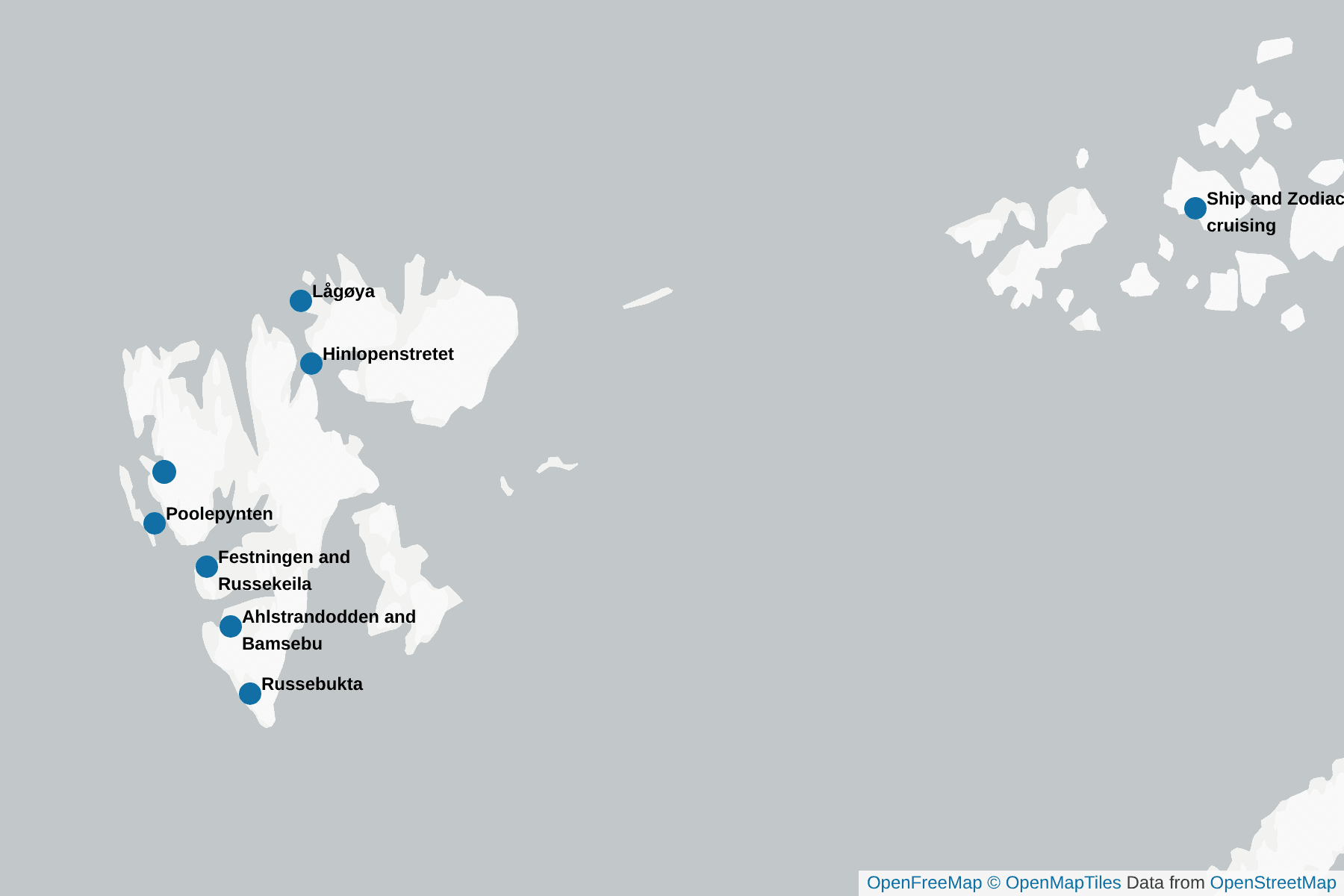
Ahlstrandodden and Bamsebu

These two sites are at the entrance to the southern arm of Bellsund - Van Keulenfjorden. Both sites, and the area between them, are scattered with remains from the Beluga, the white whale, that was hunted for the blubber and skin. There are piles of bleached bones and upturned wooden boats that were left when the area was abandoned in the 1930’s.

Beluga can be seen along the shore here. If you are lucky to encounter them it is poignant with their bleached bones on the shore.

It is popular site for a landing and to walk across the tundra between the two sites, looking for Arctic flowers, Reindeer, Arctic Foxes, and check out some hunter’s cabins and the remains of fox traps.

Also look out for Purple Sandpipers and Red Phalaropes feeding along the shoreline.

Festningen and Russekeila

There is some great tundra to explore along the flat coast on the SW side of Isfjorden, to the east of Kapp Linne.

Festningen, quite close to Barentsburg, is well known for the fossils, including the footprint of a dinosaur in sediments that have been forced by the Earth’s forces into a vertical position. Russekeila is a cultural site from the time the Russian Pomors carried out trapping in this area.

Hinlopenstretet
Hinlopenstretet

The sound between Spitsbergen and Nordaustlandet in the high Arctic, in contrast to the milder coast of western Spitsbergen. Early in the season it is locked in ice that slowly clears from the south.

The northern end can be blocked by the pack for a while, varying from season to season. Once open, it enables circumnavigation of Spitsbergen, although ice can still drift in on strong currents and block Hinlopenstretet. When Hinlopenstretet is open, but the northern end is still blocked, ships will come into the area, typically sailing along Freemansundet between Edgeøya and Barentsøya, then return.

The area is superb for Zodiac cruises and landings, and can be superb even as a ship cruise. There are plenty of seabirds, the sound can be good for whales, there are various fjords to explore, like the surprisingly arid and desert-like Wahlenbergfjorden, various island groups to explore, like Wahlbergøya, and the chance to experience what is described as the polar desert. Three locations stand out as highlights in whole of Svalbard, the ice cliff Bråsvellbreen, the Walrus Haul out at Torellneset , and the bird cliff at Alkefjellet.

Kongsbreen og Tre Kroner
Kongsvegen and Kongsbreen

The inner part of Kongsfjorden is popular for ship cruising and especially Zodiac cruising with the mountain scenery, some impressive glacier fronts, and the chance to explore the ice floes looking for wildlife, and the chance of a bear.

Also keep a look out for Long tailed Jaegers, one of the few places they breed in Svlbard is on the island of Ny London in the middle of Kongsford. A number of lakes and pools in the region can attract a range of waterbirds.

Spitsbergen
Lågøya

This island, and the associated smaller islands, is off the NW coast of Nordaustlandet. Lågøya means ‘low island’, and it is the site of a Walrus haul out and is great for bird life, with the chance of Sabine’s Gulls that are attracted to the lagoons on the island.

Part of the island is sea¬so¬nal¬ly pro¬tec-ted and off limits and landings are often thwarted by the presence of a bear, or bears. It is an area where there can be loose pack ice when the pack, further to the east, is still too compact to sail though. It means this location very popular for Zodiac cruising with the wildlife that can be encountered. There is at least one old hunter’s cabin on the island, but conditions were particularly harsh on Lågøya, some perishing on the island, making hunters reticent of over wintering here.

Ny Ålesund
Ny Alesund

The World’s northernmost year-round community and a site of cultural importance with layers of history. Originally it was a remote coal mining town, known as Kings Bay, until a serious accident in 1962.

The location meant King’s Bay was the starting point of various historical attempts to reach the North Pole, and the mast for Nobile’s airships can still be seen. Today it is a centre for international Arctic research, with traditional houses of when it was King’s Bay alongside modern bases for various countries. It is great to walk around the town and tourism also plays a role and ships can come alongside at the dock (one of the few docks apart from Longyearbyen and Barentsburg in Svalbard). There are shops, a museum, and the most northerly post office in the World. It is also great for birds, including Barnacle Geese (perhaps the most well studied wild geese in the World), Red-throated Loons on the lake, and the chance of an Ivory Gull by the dog kennels.

Ny London, Svalbard
Ny London

This location is on the island of Blomstrandhalvøya that is in Kongsfjorden and just across the bay from Ny Ålesund. It is the site of an ill-fated attempt to extract the marble deposits by the Northern Exploration Company and the adventurer Ernest Mansfield.

A lot of money and effort was put into the project, but it turned out the marble would shatter as it warmed up! Today there are the remains of the marble quarry and debris from the mine, including wooden huts, and various bits of machinery, including a crane and a rusting steam engine. As well as the cultural remains it is a good place for wildlife, including the elegant Long-tailed Skuas that breed here that are very rare elsewhere in Svalbard, with the Arctic Skua being far more abundant.

Poolepynten
Poolepynten

This location is outside Isfjorden on the long island of Prins Karls Foreland, but is within the reach of day trips from Longyearbyen, on a long boat ride.

It is known for the Walrus haul out, one of the few relatively close to Longyearbyen, and is popular as a landing for cruise ships. It is a great location to experience a haul out, and they are so used to people, individuals swimming along the shore sometimes come for a closer look! The beaches are covered in logs that have drifted all the way across the Arctic Ocean from Siberia, just watch out for Arctic Terns. The lagoon to the rear can be great for Purple Sandpipers, Red Phalaropes, and Red Throated Loons.

Russebukta Svalbard
Russebukta

On the SW coast of Edgeøya, the name means Russian’s Bay from when Pomor hunters were in the area.

This is an area of boggy tundra with numerous lakes that is a great location for a wide range of Svalbard birds and Reindeer in the Søraust-Svalbard Nature Reserve.

Aurora Expeditions Sylvia Earle South Georgia & Antarctic Odyssey
Ship and Zodiac cruising

With the myriad of islands and channels, and the ice, there needs to be a lot of flexibility of where to explore within the Franz Joseph archipelago. But there is the chance to see a range of Arctic wildlife, such as the Polar Bear and Walrus, plus species like Bowhead Whale and Narhwal that are scarcer in Svalbard waters.

Many of the ships that head up to the north pole pass through the islands.

Our trips to spot the Red Phalarope

Bruna Garcia

Your contact

Bruna

Call now

+1 347-493-2978

Weekdays from 5:00 to 16:00 EST

​
​
​
​
​
​
Bruna Garcia