Polar Tours Logo 1200px full color svg

All Dates & Prices

Trip Type

Antarctica

Arctic

Info

Home

All Dates & Prices

Trip Type

Ship Size

All Ships & How to choose the best

Large Ships

Micro-Cruises

Mid-Sized Ships

Small Ships

Ways to travel

Classic Cruises

Discounted Cruises

Luxury Cruises

Polar Expeditions for Solo Travelers

Premium Cruises

Antarctica

Antarctica

All Dates+Prices

Antarctic Season 2025/2026

Antarctic Season 2026/2027

Info

Air Cruises: Fly to Antarctica!

Antarctica Last Minute Offers

Antarctica Travel Information

Download Our Free Antarctica Guidebook

Weather in Antarctica

Wildlife of Antarctica

Top Destinations

Antarctic Sound & Weddell Sea

Cruises beyond the Antarctic Circle

South Georgia

South Shetland Islands

Travel Styles

Antarctica Luxury Cruises

Cheapest Antarctica Cruises

More Comfort: Antarctica Large Ship Cruises

Small Ship Expedition Cruises to Antarctica

Arctic

Artic

All Dates+Prices

Info

Arctic Travel Information

Arctic Trips for Solo Travelers

Download Our Free Arctic Guidebook

Wildlife of the Arctic

Top Destinations

Canadian Arctic

Greenland

Iceland

North Pole

Northern Lights Cruises

Northwest Passage

Svalbard

Travel Styles

Arctic First Class Cruises

Arctic Luxury Cruises

Arctic Small Ship Expedition Cruises

Artic Last Minute Cruises

Discounted Arctic Cruises

Polar Bear Tours

Small Ship Cruises in Svalbard

Info

Info

Activities & Add-Ons

Blog

FAQ

Free Polar Guidebook

Our Team

Sustainable Tourism

Travel Insurance for EU + CH Residents

Trips for Solo Travelers

What our travelers say

YouTube: Polar Expert Talks

Your Advantages

All deals in one place

Best Price Guarantee

Free Video Consultation

No Hidden Fees

Unbiased Recommendations

Why book with us?

Your money is protected

Contact us

Weekdays from 5:00 to 16:00 EST

$
​
​
$
​
​

Sign up for our Polartours newsletter

Get travel inspiration from Antarctica and the Arctic and receive exclusive discounts.

​
Polar Tours Logo 1200px full color svg

Luxury Cruises

Island Sky

SH Diana

Scenic Eclipse I

Silver Cloud

Silver Explorer

Silver Wind

Ultramarine

Premium Cruises

Douglas Mawson

Freya

Greg Mortimer

Hebridean Sky

Kinfish

Magellan Discoverer

Magellan Explorer

Classic Cruises

50 Years of Victory

G-Expedition

Hans Hansson

Hondius

Janssonius

Kapitan Khlebnikov

MS Balto

Further Links

Best Price Guarantee

Ernest Shackleton

Join our team!

Last Minute Deals

Mandatory Insurance

Packing List

Trips departing from Punta Arenas

Further Information

FAQ

Terms & Conditions

Careers

ventura TRAVEL

Contact Us

🇺🇸 +1 347-493-2978

🇬🇧 +44 20 4571 8661

🇩🇪 +49 30 3119 3691

🇫🇷 +33 1 76 38 06 39

service(at)polartours.com

Contact Form

Weekdays from 5:00 to 16:00 EST

Caribou

Caribou

The mythical reindeer, vital to native Arctic peoples for millennia

What you need to know about the Caribou

Our Expert Says… "Female caribou don't lose their antlers over winter - so Santa's Rudolf and his crew were obviously not males! The caribou has always been such an important species for both humans and hunting mammals in the arctic north that the human and natural history of the north would have been very different without them."

The caribou is known as the reindeer in Europe. They are found in the arctic and sub-arctic areas of North American and Eurasia in habitats including forests, mountains, and tundra. There are more than 15 sub-species of caribou currently recognized.

Caribou are both migratory and sedentary and their herding habits vary by location. There is a migrating herd of Siberian caribou that consists of up to 1 million individuals, although North American populations seem to be under pressure, with herd sizes down to under 10,000.

Some of the North American sub-species can claim to have the longest migrations of any land mammal, covering over 3,000 miles every year. As well as long-distance stamina, caribou can move quickly when they need to. Adults can run at up to 50mph, and even day-old calves could outsprint Usain Bolt!

Caribou have special adaptations to survive in harsh Arctic weather. One such is that the arteries and veins in their legs are closely intertwined, allowing the returning cooler blood in the veins to lower the temperature of the arterial blood. This method of heat exchange minimizes the amount of heat the caribou loses through the skin, enabling them to regulate their body temperature in greater extremes of weather than other mammals.

Males are larger than females, typically weighing around 180kg (400lb) and standing up to 1.5m (60”) at the shoulder. There is a sub-species called the Svalbard Reindeer that is much smaller, typically standing half the size at the shoulder compared to other sub-species.

Caribou has always been an important resource for native Arctic peoples. They are hunted for meat, fur, and antler across their whole range. North American caribou were not traditionally herded, whereas the northern European reindeer was and is the world’s only semi-domesticated deer, having been domesticated for centuries by various native peoples, including the Sami.

Pictures of Caribou

Caribou

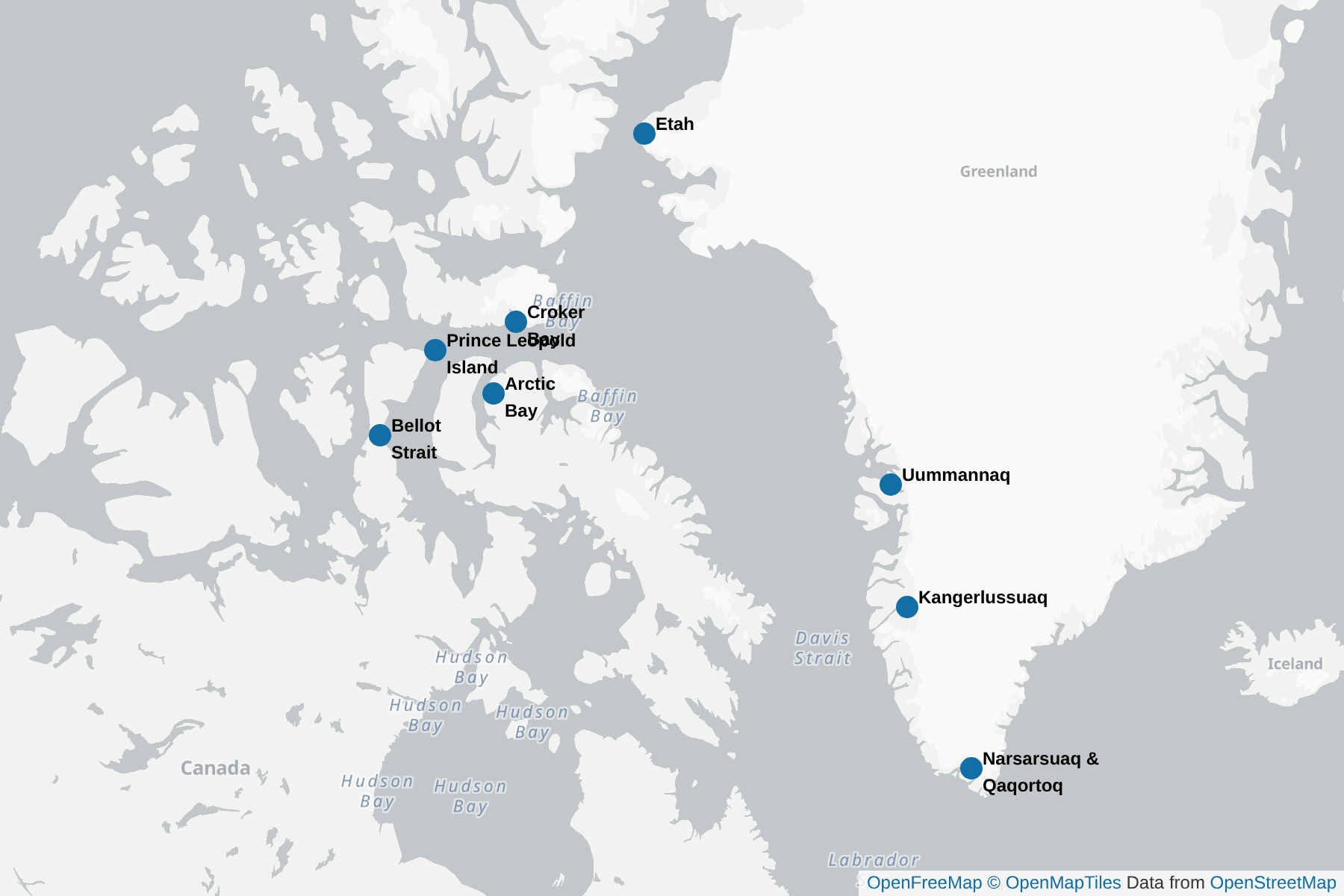
Highlights where the Caribou can be seen

Arctic Beauty - Svalbard - Woodfjorden
Arctic Bay

On Admiralty Inlet on the very northwest side of Baffin Island.

Named after the whaling ship, the Arctic, in 1872, it is the site of quite a large community (mainly Inuktitut) called Ikpiarjuk, and a popular location to visit for expedition cruise ships. There is a museum and Ikpiarjuk a good place to learn about the culture. The area is great to ship cruise and explore for wildlife.

Narwhal
Bellot Strait

Narrow strait separating Somerset Island to the north from Murchison Promontory of Boothia Peninsula to the south, the northernmost part of mainland America.

The 2km (1.2 mi) wide and 25 km (16 mi) strait connects the Gulf of Boothia, Prince Regent Inlet, and Brentford Bay to the east with Peel Sound and Franklin Strait to the west. It became a strait on ‘one’ of the NW passage routes. On a map of the Canadian Arctic, unless you look in detail, it is easy to assume the Boothia Peninsula and Somerset Island is one peninsula. In many ways, with Bellot Strait locked in ice much of the year, it is like the peninsula. Since it is so narrow, it can be a place to look for Narwhal, and, along the shore, Polar Bear, or even wolf.

croker bay
Croker Bay

One of the deeper inlets into Devon Island, on the southeast side, but further west from Dundas Harbour. Great ship cruising with icebergs and the flat-topped mountain geology of this part of Devon Island.

pause for reflection
Etah

At the very northern end of Baffin Bay and the very northwest of Greenland, Etah looks across the Nares Strait to Ellesmere Island, the area usually frozen from October to July.

The area was the crossing point to Greenland for cultures 4,400 and 2,700 years ago, the Thule culture migrants less than a thousand years ago, and the point of the last migration of the Inuit from Baffin Island reached the coast of Greenland in 1865 Etah was also a starting point for various expeditions attempting to get to the North Pole.

Today the channel, when frozen, continues to be a crossing point for wildlife from Canada to Greenland, even Wolverine get across. Etah used to be the most-northerly populated settlement in the world, but it was abandoned (Inuit moving south to Pituffik) due to the harsh conditions.

Kangerlussuaq Airport
Kangerlussuaq

North of the Arctic Circle and deep in the long Kangerlussuaq fjord, it was the site of a WWII airport, then for refuelling for trans-continental flights.

The airport and the fjord are used as pick-up and drop off for cruise ships exploring the remoter parts of west Greenland. There are few roads in Greenland, but a 25 km dirt road connects the town with the mighty ice cap. Nowhere else is there easier access to the Greenland ice cap. Area also good for caribou, Musk Ox (actually introduced to this part of Greenland), and to look out for White-tailed Eagles.

Qaqortoq, Greenland
Narsarsuaq & Qaqortoq

This area of deep fjords and lush scenery was probably the area where that the Vikings came up with the name of Greenland, and where first church in the New World was built.

Icebergs contrast with the verdant landscape that is great explore. Qaqortoq is South Greenland’s largest town with lots of colourful houses. It is also a good area to see White-tailed Eagles and other Greenland wildlfe.

Looking west towards the island
Prince Leopold Island

This island is in a key location in Lancaster Sound at the junction of Prince Regent Inlet and Barrow Strait, off the northwest coast of Somerset Island. It has some really impressive and steep seabird cliffs that is one of the most important sites in the Canadian Arctic and a bird sanctuary.

Also good area to look for marine mammals and other Arctic wildlife.

Uummannaq
Uummannaq

Town on small island of the same name with a prominent peak at the entrance of Uummannaq Fjord.

Photogenic location for the town, the largest north of Ilulissat, with a museum and the chance to experience a Greenland community. The fjords great for the scenery and icebergs and whale watching. In the region is Qilakitsaq, where there is a site with Innuit burial remains.

Our trips to spot the Caribou

Bruna Garcia

Your contact

Bruna

Call now

+1 347-493-2978

Weekdays from 5:00 to 16:00 EST

​
​
​
​
​
​
Bruna Garcia